You Searched "Mackie." You Got a Daphne Plant. Here's What That Costs You.
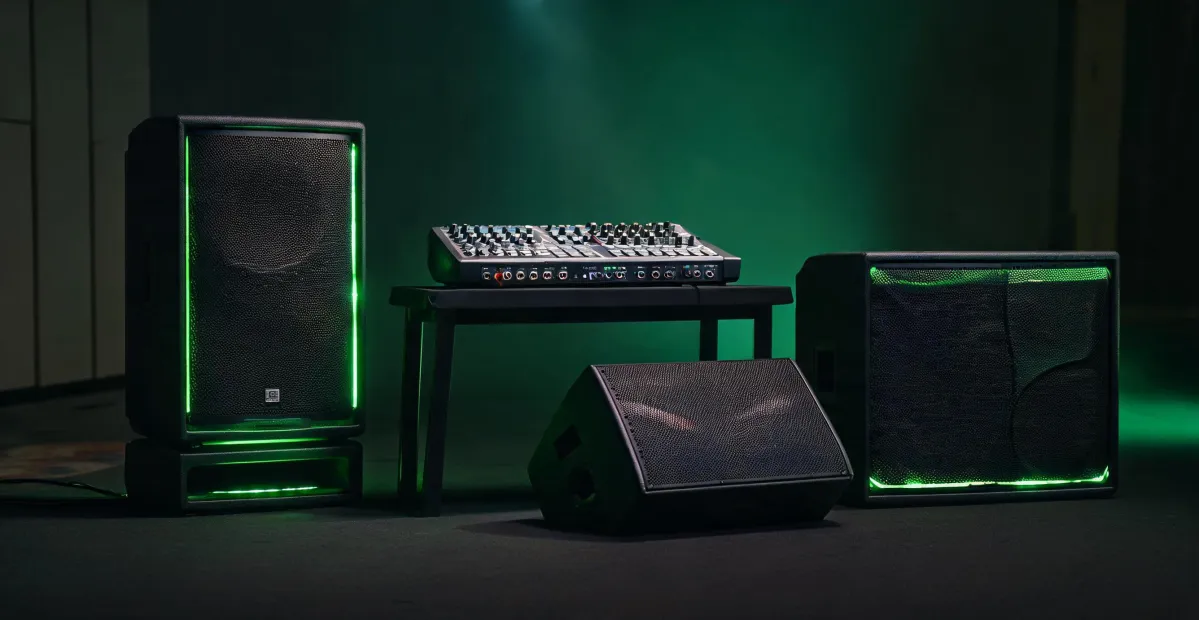
Last week I typed Mackie portable speaker into a search engine. The first result was a nursery page selling Carol Mackie Daphne for sale. The second was a listing for a "used mackie 2022 srmflex powered speaker." The third was a blog post about crossovers.
I'm not an audio engineer. I'm the office administrator who buys the audio gear. I manage AV purchasing for a 40-person company—roughly $20,000 a year across six vendors—and I report to both operations and finance. When I took over purchasing in 2020, I thought the hard part would be negotiating. It wasn't. The hard part is figuring out what I'm actually buying.
If this only happened once, it'd be a funny story. It's not once. It's every single time.
The Searches People Actually Use
Carol Mackie Daphne for sale. You're not shopping for a shrub, but the search engine doesn't know that. "Mackie" is also a horticultural name, so the plant and the PA share a keyword. Add "audio" and you're closer. Add a model name and you're actually looking for gear.
Used Mackie 2022 SRM Flex powered speaker. This is closer to useful, but "used" doesn't tell you condition, firmware version, or whether the original cable and cover are included. It's a listing title, not a spec sheet.
Audio mixer extension. When people search this, they usually don't need an extension—they need more inputs. It's a need, not a product category. The search engine doesn't know that either.
Loudspeaker cross section and what's a loudspeaker. These are important questions, but they won't tell you which one to buy. You need the rear-panel photo, the input list, and the weight.
The Deep Problem: Search Is Not a Spec Sheet
Brand collisions and the "Carol Mackie" trap
Carol Mackie Daphne for sale is the perfect example of keyword collision. "Mackie" is an audio brand and a plant cultivar. If you drop the word "speaker" from your search, you can spend an afternoon reading about variegated leaves. That's not a failure of intelligence. It's a failure of context.
Add "audio" and you hit another layer: product names like SRM, Thump, DL, CR, and SRM Flex. They're all real products, but "Mackie" alone isn't a model number. You need the model number to get the spec sheet.
The used market hides more than it reveals
Here's a typical listing: "used mackie 2022 srmflex powered speaker, $850." No original invoice. No mention of accessories. No firmware version. The seller says "practically new."
Per FTC advertising guidance (ftc.gov/business-guidance/advertising-marketing), claims like "practically new" have to be truthful, not misleading, and substantiated. But with used gear, the claim is only as good as the seller's ability to back it up. Usually they don't.
I want to say I've seen "like new" listings show up with scratches and no cover, but don't quote me on that—it's the pattern that matters. After a few duds, you learn: the listing title is not a spec sheet.
The vocabulary mismatch
"Audio mixer extension" is a great example. If you need more channels, you don't need an extension cable. You need a bigger mixer, a submixer, or a digital stagebox. Search for the exact phrase and you'll find adapters that won't solve the problem.
"What's a loudspeaker?" Technically, it's a transducer that converts an electrical signal into sound. For purchasing, the relevant answer is simpler: a powered loudspeaker has an amplifier built in; a passive one doesn't. A loudspeaker cross section shows the driver, the voice coil, and the cabinet. It doesn't show whether the DSP has limiters or whether the input accepts line level. Those are the details that actually change your buying decision.
This gets into speaker design territory, which isn't my expertise. I can't speak to voicing or beamwidth. What I can tell you from a procurement perspective is that specs beat keywords.
What This Confusion Costs You
First, money. In April 2025, I checked used online listings for a Mackie SRM Flex. Prices ranged from about $700 to $1,150 (Source: online gear marketplace listings, April 2025; verify current pricing). That's a huge spread for the same model. Condition, accessories, and history should explain the difference—but many listings don't include those details.
Second, compatibility. I once searched for an "audio mixer extension" because our conference room needed more line inputs. I bought a device that looked right, then realized it was a standalone mixer without enough outputs to feed the main system. The return shipping ate the savings. Everyone told me to verify specs before approving. I only believed it after ignoring it once and eating a $400 mistake. Oh, and the return shipping was on me.
Third, trust. When I approve a purchase, finance expects it to work the first time. A wrong order doesn't just cost money—it makes me look bad to the people who rely on the system. That's harder to put on a spreadsheet.
The Cheaper Way: Buy the Spec, Not the Keyword
The fix isn't complicated. Stop searching for what the problem feels like—or rather, stop searching for the category and start searching for the model. If you know the model number, search that. If you don't, start from the manufacturer's current lineup, not from random listings.
For a loudspeaker: know whether it's powered or passive. Know the inputs and outputs. Check the weight and the rear-panel photo. A loudspeaker cross section is interesting, but it won't tell you if the unit fits through your storage door.
For a used powered speaker: ask for three things—serial number, original invoice, and firmware version. In that order. If the seller can't provide them, factor that into your offer. Again: per FTC guidelines, a claim like "like new" must be truthful and substantiated. Ask for the substantiation.
For an "audio mixer extension": describe the need, not the phrase. "I need eight more mic inputs for a conference room" is a better search than "audio mixer extension." You might end up with a stagebox or a larger mixer. Don't let the word "extension" trick you into buying a cable.
This approach worked for us, but we're a single-location office with predictable needs. If you're a rental company sending gear out every weekend, your risk tolerance is different. Your checklist should be stricter.
I've learned to ask "what's NOT included" before "what's the price." The vendor who lists all fees upfront—even if the total looks higher—usually costs less in the end.
It took me three years and about 150 orders to understand that. Now my first question is never about price. It's about what I'm being sold.
The next time you type "Mackie" and a Daphne shrub appears, that's not a sign to give up. It's a sign to add one more word: specs.

Elise Marceau
Elise Marceau is an LED display and digital-signage systems analyst covering LED video walls, modular screens, transparent LED, control processors, and indoor or outdoor signage. She applies IEC 62368-1 safety principles while comparing pixel pitch, luminance, contrast, refresh rate, colour uniformity, viewing angle, ingress protection, power density, module serviceability, and signal redundancy. Her specification guides help integrators, venue operators, retailers, and procurement teams align viewing distance, ambient light, content format, installation access, electrical load, and lifecycle support.