Dealer support for working venues Portable PA, loudspeaker, monitor, and mixer guidance for working venues
Mackie systems in different venue applications
Applications by room type

Mackie Industries and venue sound applications

Every room asks a different question. A production crew wants quick deployment and enough headroom. A conference space needs speech to stay intelligible at the back row. A school gym may require portable gear that survives many hands. A house of worship needs volunteers to feel comfortable while performers hear the stage. Mackie application guidance keeps those differences visible before products are compared.

Built for the room

Match the system to the way the room is used

Live sound and touring

Portable loudspeakers, subs, monitors, and compact mixers help crews set up repeatable rigs for small festivals, clubs, corporate stages, and DJ events. The priority is predictable coverage, clear monitoring, and equipment that can move without slowing load-in.

Installed venues

Bars, community rooms, multipurpose halls, and performance spaces need systems that staff can operate without constant outside help. Recommendations focus on room coverage, mounting or placement, control simplicity, and upgrade options.

Worship and community spaces

Volunteer-friendly operation matters as much as loudness. Mackie paths can support speech, music, playback, and stage monitoring while keeping the control surface approachable for rotating teams.

Education and assemblies

Schools often need sound for gyms, auditoriums, classrooms, and temporary outdoor events. Portable PA speakers and mixers should be understandable, durable, and flexible across many schedules.

Corporate and conference rooms

Speech clarity, quick setup, and minimal distraction lead the decision. Compact systems can support panels, training sessions, product launches, and hybrid event audio feeds.

Hospitality and retail events

Restaurants, stores, and pop-up activations need controlled sound that feels polished without overwhelming guests. Product choices balance footprint, bass impact, and clean visual presence.
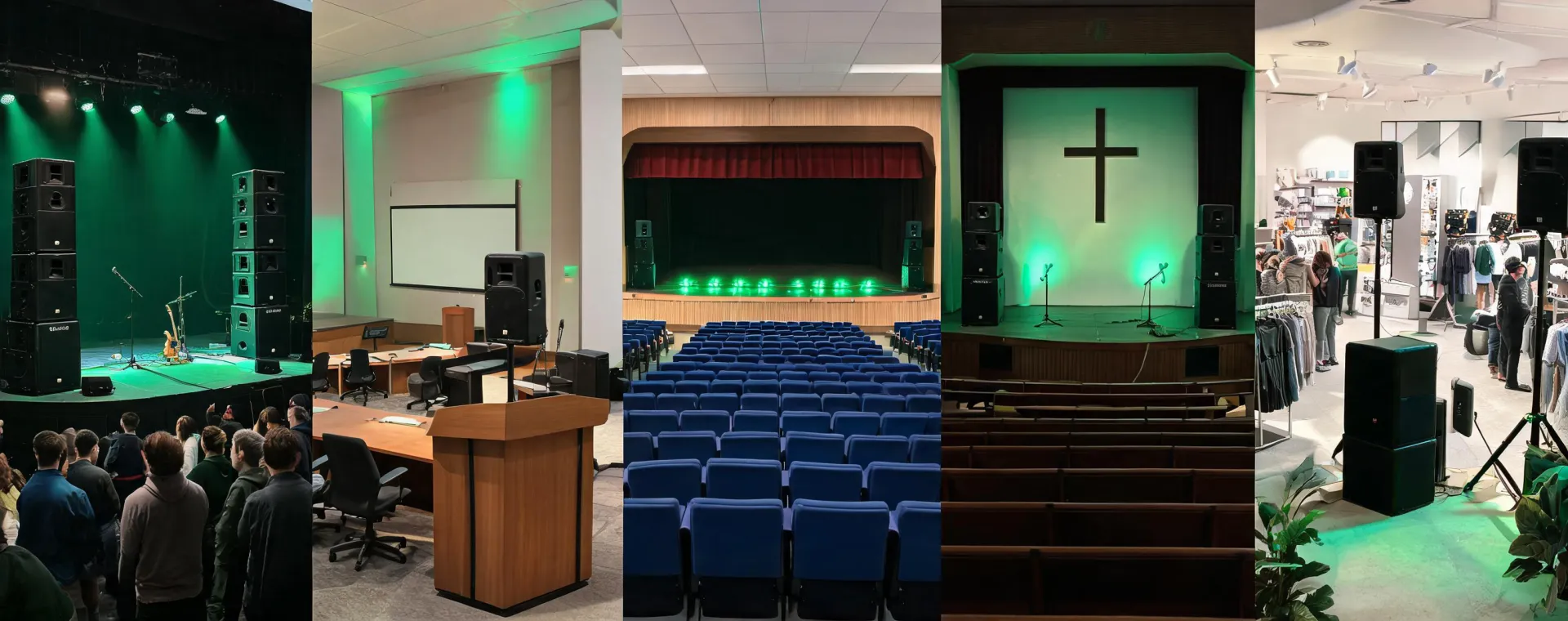
Selector guide

Use the checklist before choosing a category

This guided approach keeps buyers from starting with wattage alone. Audience size, distance to the farthest listener, music style, available operators, and setup frequency usually explain more than a single specification. A small speech system may need clear coverage more than deep bass. A mobile DJ package may need subs and quick wiring. A worship room may need monitors and mixer channels before adding more main speakers.

Selection considerations

Honest trade-offs we talk through before the room is fixed

None of these choices has a single right answer. The friendly version of the truth is that each option trades one practical benefit for another, so the answer depends on the budget, the crew, and how the room is actually used.

Powered vs. passive PA

The case for powered: a 1000-1300 W active 12-inch top weighs around 18-21 kg, carries its own amp and DSP, and a two-person crew can fly it on a pole and be running in minutes — ideal for the small venues and mobile rigs Mackie serves.

The case for passive: separating speaker and amp lets an installer fix or upgrade either half, run long speaker cable to ceiling clusters, and avoid putting heat-sensitive amplifiers up where they cannot be serviced. For fixed installs that argument is strong.

How we land it: portable and DJ work usually wins with powered; permanent ceiling or distributed-zone installs often favor passive plus a rack amp. We say which one and why, not just "powered is easier."

Point-source vs. line array

Point-source: one or two boxes per side, predictable 90° x 60° coverage, low cost, and nothing to fly. For rooms under about 150-200 listeners it is usually the more honest spend.

Line array: tighter vertical control throws speech further into a deep or balcony room and keeps level even front-to-back, but it adds rigging, weight, electrical load, and a real safety review. Buying an array for a 120-seat bar is paying for coverage the room cannot use.

How we land it: array advice starts at audience depth and reverberation, not at "bigger is better." Most Mackie buyers are better served by a second point-source top or a sub than by an entry array.

Onboard DSP vs. an external processor

Onboard DSP (presets, feedback control, basic EQ inside the cabinet) keeps a volunteer-run worship or school system to one device and far fewer cables. An external processor gives a touring engineer measurement-based tuning, multiband limiting, and delay alignment across many boxes. One favors simplicity, the other favors precision; we match it to who runs the system each night.

Bring us the room

We will help connect the application to the right Mackie product family.

Send a few details about the venue, audience, program type, and operator experience. We will shape a clearer category path before you request a quote.