PA System Buying for Office Events: An Admin's FAQ (2025 Update)
-
Q1: We need a PA system for office events. Where do I even start?
-
Q2: I keep seeing "Mackie 808S for sale" listings. Is buying used worth it?
-
Q3: Do we actually need a subwoofer, or is that overkill?
-
Q4: What about amplifiers? Someone recommended the NAD M23 Masters stereo power amplifier.
-
Q5: How do I avoid the mistakes you made?
-
Q6: How do I justify the cost to finance?
-
Q7: Any final advice for someone in my position?
I'm an office administrator at a 120-person company. Since 2021, I've managed about $85K a year in vendor spend—office supplies, catering, AV rentals, the usual. Last year, our ops director asked me to handle a full PA system purchase for our quarterly all-hands and the annual customer appreciation event. That meant learning the difference between a "speaker" and a "powered speaker," and why some subwoofers cost $200 while others cost $2,000.
Below are the questions I actually asked—and the answers I wish someone had given me before I placed our first order.
Q1: We need a PA system for office events. Where do I even start?
Start with the room, not the gear. I learned that the hard way. Our first event was in a 3,000 sq ft conference room with 15-ft ceilings, and I ordered a single Mackie PA speaker (a Thump series model) thinking it would cover the space. It didn't. People in the back couldn't hear the CEO's presentation clearly. So glad I double-checked the return policy before that event—we ended up swapping for a pair with stands.
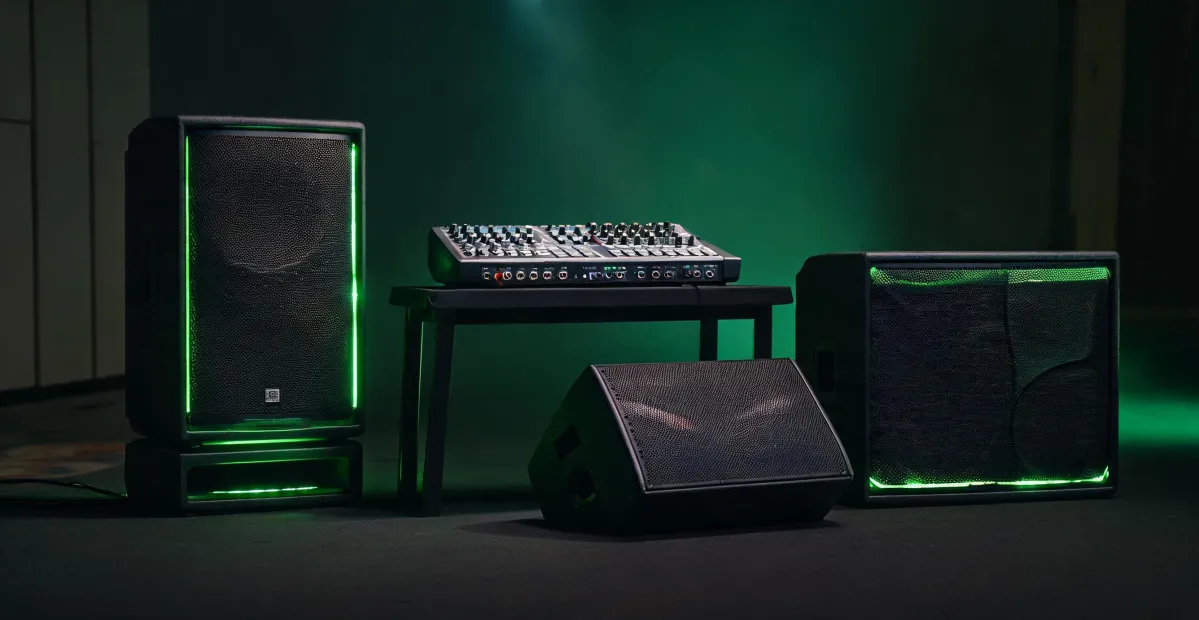
The rule of thumb our AV installer gave me: for spoken-word events, you want one powered speaker per 50-75 people in a room with normal acoustics. For music playback, double that. Mackie's SRM series (like the SRM450) is a common choice for this because they're powered (amp built in), have decent coverage patterns, and you're not running separate speaker cables and amps everywhere. Plus—and this matters for us—they're portable enough that one person can set them up.
Q2: I keep seeing "Mackie 808S for sale" listings. Is buying used worth it?
Depends on your risk tolerance. The Mackie 808S is a powered mixer—it's both the mixer and the amplifier in one box. If you find one for sale, you're looking at gear that probably dates back to the early 2000s. They were workhorses (seriously, those things were built like tanks), but at 20+ years old, capacitors dry out and solder joints crack.
My take: if you're buying for a business, don't buy a 20-year-old powered mixer unless you have a repair budget and a backup plan. For one-off events, renting makes more sense. For ongoing use, a new Mackie powered speaker like the Thump215 or SRM series will cost you more upfront but comes with a warranty and won't fail mid-presentation. That said, if you find an 808S in good condition for under $200 and you're comfortable with the risk, it's a solid backup unit.
Q3: Do we actually need a subwoofer, or is that overkill?
For pure spoken-word presentations? Overkill. Skip it. Your standard PA speaker handles voice fine—subwoofers add low-end frequencies that don't exist in speech.
But if you're playing music (background during networking, walk-in music, that kind of thing), a subwoofer makes a noticeable difference. I didn't believe this until we tested it side by side. Without a sub, music sounds thin. With one, it fills the room. The KRK10S subwoofer is a common option in this space—it's a 10-inch powered sub, designed more for studio monitoring than live sound, but it works fine for small-event playback if you're not pushing high volumes. For larger rooms, you'd want a 15-inch or 18-inch sub.
And yes—I've seen "Godzilla subwoofer" searches too. That's not a specific brand; it's usually a marketing term for high-output subs. Don't let the name convince you it's right for your room. Match the sub to your space, not the label.
Q4: What about amplifiers? Someone recommended the NAD M23 Masters stereo power amplifier.
That's a $3,000+ amplifier. Unless your office is secretly running a high-end listening room, you don't need it. The NAD M23 is designed for audiophile-grade stereo systems—think dedicated music rooms, not conference rooms with drop ceilings and fluorescent lights.
Here's the thing I wish I'd understood earlier: powered speakers (like most Mackie PA speakers) have amps built in. You don't need a separate amplifier at all. Passive speakers require an external amp, but for 95% of office AV setups, powered is simpler, cheaper, and less prone to wiring mistakes. That NAD M23 would be fantastic in the right context—it's just not the right context for a company all-hands.
Q5: How do I avoid the mistakes you made?
My 8-point checklist, developed after two failed purchases and one return:
- Measure the room—length, width, ceiling height. Write it down.
- Count attendees—and add 20% buffer for standing-room events.
- Decide powered vs. passive—powered = simplest for most offices.
- Check the return policy—before ordering, not after. I learned this the hard way.
- Confirm warranty terms—business purchases sometimes have different coverage than consumer.
- Test in the actual room—specs on paper don't account for that weird echo in your lobby.
- Get it in writing—if a vendor promises "it'll cover 200 people," get that in an email. I skipped this once and spent three weeks arguing about a return.
- Plan for setup time—a "portable" PA system still takes 20-30 minutes to set up properly.
Five minutes of verification beats five days of correction. That's not a slogan—it's what I tell myself every time I'm tempted to skip step 6.
Q6: How do I justify the cost to finance?
Frame it as cost-per-use. If you host 6 events a year and the system costs $1,200, that's $200 per event. Renting comparable gear runs $150-$300 per event plus delivery, plus the risk of equipment failure that you can't control. After roughly 8 events, buying becomes cheaper. Plus, owned gear is available for last-minute needs—that unexpected client visit, the CEO's impromptu town hall.
I put together a one-page comparison for our finance team: rental costs over 12 months vs. purchase price plus maintenance. They approved it in two days. If you want the highest total value, buy quality once and take care of it—my experience has been that cheap gear costs more in replacements and frustration.
Q7: Any final advice for someone in my position?
You're not an AV professional, and that's fine. You don't need to be. You need to know what questions to ask and when to bring in help. For anything over $2,000 or involving permanent installation, hire an AV consultant for a few hours. It's worth it.
And when you're comparing Mackie PA speakers to whatever else comes up in your search results—stick to your checklist. Reliability, warranty, and support matter more than spec sheets. I've seen too many offices buy on specs alone and end up with gear that sounds great on paper but fails when it matters.

Nadia El-Sayed
Nadia El-Sayed is an industrial vacuum and dust-extraction analyst covering wet and dry vacuums, mobile dust extractors, source-capture units, separators, filters, and collection systems. She uses IEC 60335-2-69 for applicable commercial vacuums and dust extractors while comparing airflow, static pressure, filtration class, filter area, dust-loading behavior, automatic cleaning, container volume, hose loss, noise, and continuous-duty limits. Her application guides help workshops, factories, contractors, and safety teams match dust characteristics, capture demand, disposal method, electrical supply, and exposure-control procedures.