The 42-Hour Warehouse PA Rescue: Mixers, Subs, and a KEF LSX Curveball
4:12 p.m. Thursday: the call
In March 2025, at 4:12 p.m. on a Thursday, I got a call from a creative agency producer. She needed a full audio setup for a pop-up event in an old warehouse—doors opening Saturday at 10 a.m. That gave us 42 hours. Not terrible. Except the client had already rented a pair of KEF LSX speakers for a cozy listening corner, and now wanted a subwoofer for KEF LSX, a white audio mixer, and something she called a wave audio mixer.
I coordinate rush AV rentals for a regional production company. I have handled 200+ last-minute orders in seven years, including same-day turnarounds for agency and event clients. So my first thought was: easy. Pair the KEF LSX with a small sub, add a Mackie mixer, done.
I was wrong. Not about the gear—about the room. The warehouse was 4,000 square feet with concrete floors and a 22-foot ceiling. KEF LSX are excellent nearfield monitors. They are not PA speakers. If you have ever tried to cover a warehouse with bookshelf speakers, you know that sinking feeling when the first kick drum disappears into the room.
Friday morning: inventory and assumptions
Friday morning, I pulled what we had. Two Mackie Thump212 powered speakers. One Mackie Thump18S subwoofer. A Mackie ProFX10v3 mixer. A pair of Mackie S500 speakers in the back—well, passive S500s, which means they need an external amp. That detail mattered later. I also grabbed a pair of Mackie computer speakers, the CR3-X, for the check-in desk and booth editing.
Here is where I made my first real mistake. I assumed the client's white audio mixer request was about signal flow. It was not. Her creative director wanted a white finish to match the all-white stage design. The wave audio mixer was also a terminology mix-up. She meant a mixer that shows waveforms. Hardware mixers usually do not display waveforms; that is a DAW feature. I explained that a Mackie ProFX10v3 would handle mics, DJ inputs, and USB playback, but it would not show waveforms on a screen. She said, So it is not a wave audio mixer? I said, It is a mixer. The wave part is usually software.
Honestly, I am not sure why the white finish became such a dealbreaker. My best guess is the creative director had a strict visual brand guideline. We did not have a white audio mixer in stock. We had a black ProFX10v3. I offered to cover the table in white linen and keep cables hidden. She agreed. Problem solved—or rather, problem traded for a bigger one.
The KEF LSX subwoofer question
The client kept asking about a subwoofer for KEF LSX. That makes sense in a small studio. KEF LSX has a subwoofer output, and adding a compact sub can fill in the low end for nearfield listening. But this was a warehouse. We needed coverage for 200 people, a DJ set, and two panel discussions.
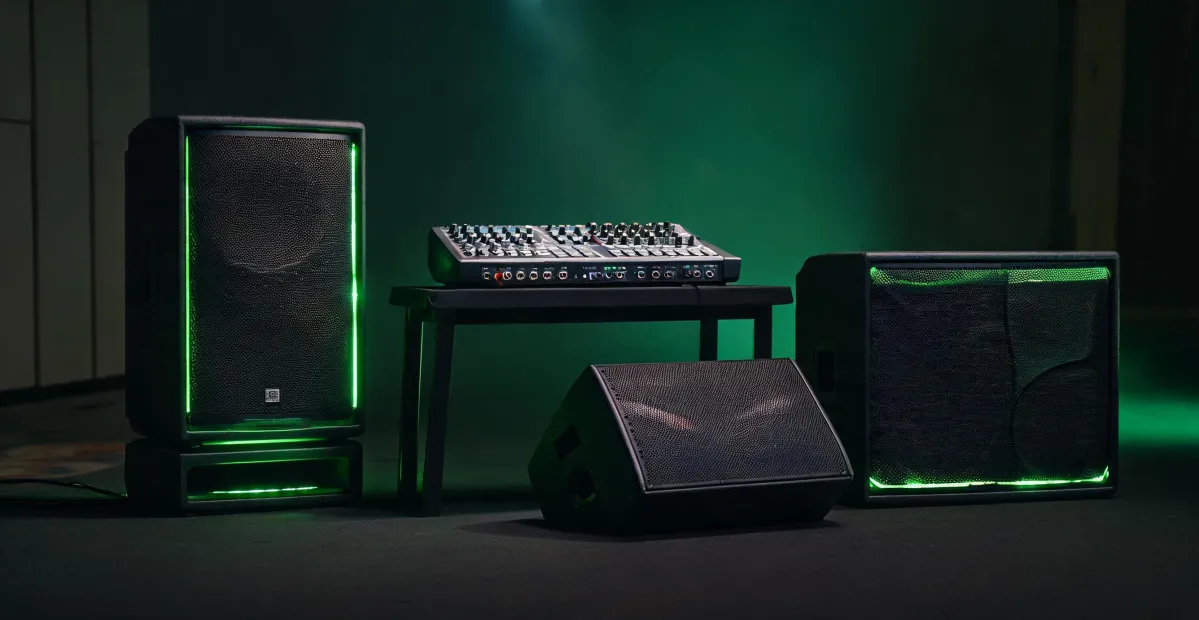
I tested the KEF LSX with a Mackie CR8S-XBT studio subwoofer. It sounded good in our shop—tight, controlled, musical. In the warehouse, it would have been a whisper. So we used the KEF LSX where they actually shine: the listening booth and check-in area. Then we put the Mackie Thump212s on stands for the main PA and the Thump18S subwoofer on the floor. The ProFX10v3 routed everything.
That said, if you are building a desktop setup and you want a subwoofer for KEF LSX, the concept works. Just match the connection. KEF LSX uses an RCA sub out. Many pro subwoofers expect XLR or TRS. You can convert, but cheap adapters can introduce hum. I would rather spend 10 minutes explaining interfaces than deal with a buzzing booth all night.
So glad I tested the KEF LSX sub-out before promising it. I almost handed them an RCA-to-XLR cable that would have introduced noise. Dodged a bullet there.
Friday afternoon: power, wireless, and the Mackie S500 detour
Friday afternoon, we walked the venue. The warehouse had two working 15-amp circuits. Two. For a PA, subwoofer, DJ gear, lights, and a coffee cart. If we plugged everything into one circuit, we would trip the breaker during soundcheck. So we split the load: main PA on one circuit, sub and DJ on the other, and the coffee cart got its own extension from the back office. We used a power conditioner with current limiting, but the real fix was math. Do not put a 1,000-watt sub and a 1,200-watt speaker pair on the same 15-amp line.
We also considered the Mackie S500 speakers as side fills. They are passive, so we would have needed an amp. By the time we found a suitable amp, the truck was already loaded. I want to say we had a Crown amp in the back, but don't quote me on that. We left the S500s in the warehouse. They would have been fine for a smaller room, but not for this one with the gear we had.
Then the wireless microphones started picking up interference from a local TV station. We switched to wired mics. Not glamorous, but reliable. The client's producer thanked me. The DJ complained. That is normal.
Saturday: showtime and the real lesson
Saturday, 9:40 a.m. We finished cable dressing and ran a final check. Doors opened at 10. The panel mics were clear. The DJ set had enough low end. The KEF LSX booth sounded detailed, and the Mackie computer speakers at check-in were fine for background music and announcements.
After the event, the producer asked me if she could use KEF LSX with a subwoofer in her home studio. Yes. That is exactly what they are for. But for a 200-person warehouse, no. An informed customer asks better questions and makes faster decisions. I would rather explain that upfront than troubleshoot a blown tweeter at 8 p.m.
Bottom line: emergency audio is less about having the most gear and more about matching interfaces, power, and expectations. Also, if someone asks for a white audio mixer, ask if they mean finish or signal flow. Half the time, they mean something else.
One more thing: I checked the Mackie spec sheets before promising the Thump18S would work with the ProFX10v3. According to FTC advertising guidelines (ftc.gov), product claims should be truthful and substantiated. That is why I do not trust forum rumors when a client's deadline is 42 hours away.

Meera Kulkarni
Meera Kulkarni is a textile-printing equipment analyst covering DTF, DTG, dye-sublimation, and eco-solvent printers with their pretreatment, powdering, curing, pressing, and finishing workflows. She uses ISO 105-C06 laundering tests for applicable printed textiles while tracking colour difference, ink laydown, transfer temperature, dwell time, curing profile, washfastness, nozzle reliability, media tension, and production yield. Her process guides help decorators, apparel producers, and print shops select equipment, inks, films, fabrics, and operating windows for repeatable output.