The Mackie Thump 215 Price Is the Wrong Number to Focus On
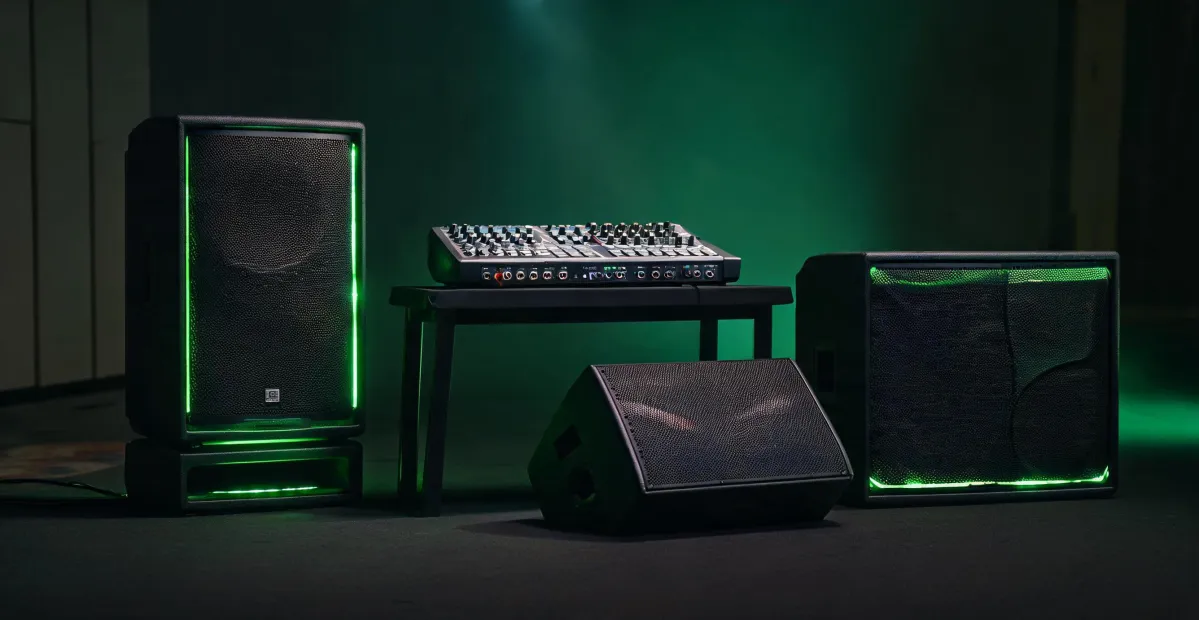
The Mackie Thump 215 price is the wrong number to focus on. In fact, it's the least interesting number on the entire spec sheet.
Let me establish who's saying this. I'm the person who reviews gear before it ships to customers. Roughly 200 audio units a year, most of them powered speakers and Mackie stage monitors. In 2024, I rejected about 12% of first deliveries. Not because they sounded bad. Because the numbers on the box didn't match what I measured.
Over four years of doing this, the sticker price stopped meaning much to me. A price is just a price. An honest spec sheet is trust you can verify on a bench.
The power consumption line nobody reads
If you've ever bought a powered speaker, you probably looked at wattage, SPL, frequency response. Maybe the weight. You didn't look at power consumption. Nobody does.
I pulled an old Alesis RA-100 out of our used rack during a Q1 2024 audit. Classic studio amp, 100 watts per channel, built like a tank. The spec sheet lists power consumption somewhere north of 250 watts. That number sits in every manual, completely ignored. Nobody asks about Alesis RA-100 amplifier power consumption. Nobody.
What's funny is that Alesis and Mackie are cousins under the same parent company. Different eras, different amp technology. So this isn't about brand bashing—it's about how much the design era matters.
Why does power consumption matter? Because 250+ watts drawn for 100 watts of output is the old class AB tradeoff. It makes heat. It makes the electric bill climb. Multiply by eight amps in a studio or six wedges in a stage monitor setup, and suddenly it's real money.
The Mackie Thump 215's class D module draws way less for comparable output. The spec is printed right there. But in a full stage display monitor rig with four to six units, the draw still adds up. At typical commercial rates, six Thump 215s for four hours a week probably lands between $40 and $60 a year. Don't hold me to the cents, but the ballpark is right.
The old-school equivalent? Triple that, at least. Over three years, that's real budget. Look, I'm not telling you to calculate amps per venue. But if you're running a permanent install or a weekly residency, the efficiency spec quietly pays for itself. That's the stuff nobody demoes at the store.
The question most buyers skip
Everyone asks which Mackie stage monitors are loudest. Or what the Mackie Thump 215 price is. Fair questions.
The better question is: what does the limiter do when I push it? Because that's what kills drivers. Not wattage. Not SPL. Limiter behavior.
I've measured budget boxes that claim 1000 watts peak and quietly strangle their drivers at a fraction of that. I've seen limiters engage so early that the published spec becomes a fantasy. Quality, in my world, is about repeatability. I can adjust my ear to almost anything in five minutes. But if I order twelve of the same model and they behave differently, that's a quality problem.
The worst part? These issues don't show up at low volume. They show up at sound check, in front of a client, with a clock ticking. I've lived that failure loop.
To be fair to Mackie, the Thump series handles this decently. The limiter clamps, the sound gets ugly, but the driver survives for another show. In my line of work, survival counts as a spec.
What a blind test actually showed
I used to believe what the forums said: premium speakers sound obviously better. You get what you pay for. Period.
Then in 2023, I ran a blind test with our technicians. Same song, same levels, two powered 15-inch boxes. One was a Thump 215. The other cost roughly double. 17 out of 25 techs picked the Mackie as 'more detailed' at moderate volume. They didn't know which was which. Basically, my own team blew up my assumption.
To be clear, the techs weren't asked to judge 'better.' They were asked which one they'd rather mix on. The Mackie won. Twice.
Now, I'm not saying the Thump 215 beats premium speakers. The gap shows up at the limit: the expensive box stays clean for another 3-4 dB. That matters in a big room. It matters less when the guitar amp on stage is already louder than your wedge.
The price difference? Half. The audible difference at normal stage levels? Smaller than the forums would have you believe. That's the part nobody posts about.
The James Loudspeaker Wilmington story
Let me make this concrete. James Loudspeaker in Wilmington, a production company doing regional festivals, bought eight Thump 215s as floor monitors. I helped spec the order. The Mackie Thump 215 price per unit made the purchase decision easy.
One box came out of the carton with the high-frequency driver half a dB hot at 8kHz. Within tolerance, technically. A vendor once called that 'industry standard.' I called James Loudspeaker and told them to swap it. Cost: a couple days of shipping. Their show schedule didn't blink.
Would I have caught that on a premium brand? Maybe. But the process worked. Published specs gave us a reference. The distributor answered the phone. And the James Loudspeaker guys told me the transparency saved them more than any discount ever did.
Is one batch proof? No. Not a scientific study. But it's the kind of thing I see play out again and again.
Why transparency beats a low price
The FTC requires that advertising claims be truthful, substantiated, and not misleading (ftc.gov).
"Truthful and not misleading, substantiated with evidence." That's the baseline. Honestly? It's a low bar. I measure against a higher one.
Because here's what happens in the real world: a brand can print '1200W peak' if the amp module can theoretically hit it, even when the limiter cuts in way before the driver sees that number. Not illegal. But it's the kind of thing that costs trust.
So the question I've learned to ask, before I ever ask for a price, is: what's NOT included on this spec sheet? The vendor who prints all the numbers upfront—even if the total looks higher—usually costs less in the end.
The Mackie Thump 215 sits at a competitive price. But the specs are printable, testable, and consistent across units. I've measured enough of them to trust that. I can't say that about every speaker I've rejected.
Now, the pushback
'I just want the cheapest speaker that won't die on me.' I get it. Budgets are real. Smaller production companies feel every dollar.
But then again, the cheapest option has hidden costs: more setup time, more failures, and the look on a client's face when the wedge distorts at sound check. If you run a rental company, that look costs more than any speaker.
The Mackie Thump 215 price already sits near the bottom of the pro-powered market. Going below it means leaving what I'd call professional territory. That's a judgment call, but I've made it after a lot of failed deliveries.
Bottom line
I've inspected hundreds of Mackie stage monitors. I've rejected the ones that didn't measure up and shipped the ones that did. The specs matched. The price was transparent. That's what trust looks like in my job.
A stage display monitor—floor wedge, side fill, whatever you call it—does one job: it tells the performer the truth about what's coming out of the mains. Your tools should tell you the truth about themselves, too.
The Mackie Thump 215 price is a good number. The spec sheet is a better one. And the trust that comes from matching the two? That's the number I actually buy.

Elise Marceau
Elise Marceau is an LED display and digital-signage systems analyst covering LED video walls, modular screens, transparent LED, control processors, and indoor or outdoor signage. She applies IEC 62368-1 safety principles while comparing pixel pitch, luminance, contrast, refresh rate, colour uniformity, viewing angle, ingress protection, power density, module serviceability, and signal redundancy. Her specification guides help integrators, venue operators, retailers, and procurement teams align viewing distance, ambient light, content format, installation access, electrical load, and lifecycle support.