Why I Almost Cost My Company $3,000 Before Learning to Think in TCO (A Mackie PA Story)
The Day I Learned 'Cheap' Isn't Always Less Expensive
It started with a frantic request from our events team in early 2024. Our old, passive PA system for the company town hall meetings was finally dead. 'Could I please get a quote for something decent that won't break the bank?' As the office administrator handling all AV gear orders for our 300-person company, this was my jam. Or so I thought.
Everything I'd read online said to find the loudest speaker for the lowest watt-per-dollar. The conventional wisdom was that price was king. So, I did what any diligent admin buyer would do: I went looking for the lowest quote on a powered speaker setup that would cover our 200-person auditorium. I found a deal that seemed too good to be true—a generic brand promising 1000 watts for half the price of a Mackie Thump.
(Note to self: never trust wattage claims without a sensitivity test report.)
Look, I'm not saying I'm an audio expert. I'm a procurement guy. But I knew the numbers looked good. The unit price was $400 less than the comparable Mackie. I placed the order for two speakers and a basic mixer, feeling pretty smug about the $800 I 'saved' the department. That smugness lasted exactly one week.
The Hidden Costs of a 'Bargain' PA System
When the gear arrived, the first red flag was the manual. It was a poorly photocopied sheet in broken English. The second red flag? The power cord didn't match our wall outlets. So, week one: $60 in adapters. Then came the setup for our monthly all-hands meeting. The speakers hummed. Not a soft hum, but a loud, distracting 60-cycle hum that the presenters' microphones picked up.
The most frustrating part? The vendor who sold it to us couldn't provide a proper invoice for the adapters I had to return, and their 'tech support' was a voicemail box that was always full. Finance rejected the expense report for the adapters because of the handwritten receipt. I ate that $60 out of my own pocket. (A lesson learned the hard way.)
We tried to make it work. We rented a ground loop isolator ($45 for the weekend), bought a different cable set ($30), and spent two hours on a Saturday trying to diagnose the issue. In the end, we returned the speakers—paying $120 in return shipping for the 'free return' policy that didn't cover freight. Total cost after all fees and lost time? The $800 'savings' was gone. The $400 difference turned into a $300 net loss.
I didn't fully understand the value of Total Cost of Ownership (TCO) until that $3,000 order (including the new Mackie gear) came back to correct it.
The Mackie Solution: A Lesson in TCO
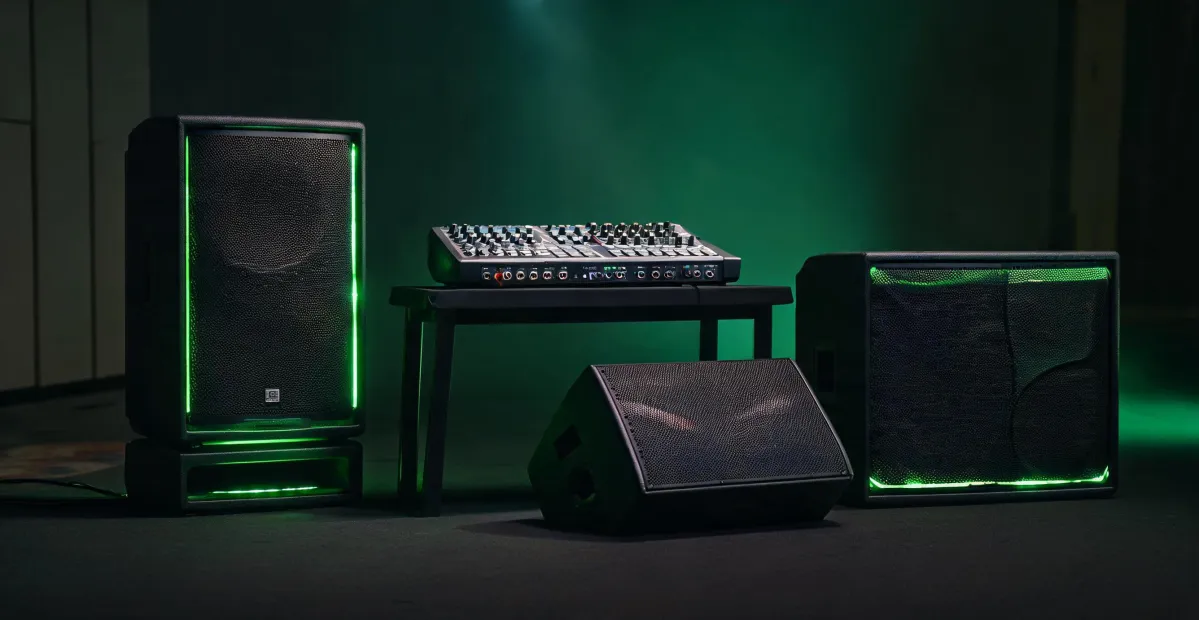
After the disaster, I went back to the drawing board. My events coordinator friend suggested I look at the Mackie PA speakers again—specifically the Mackie Reach portable PA system for our smaller breakout rooms and a pair of SRM series speakers for the main hall. I was hesitant because of the upfront cost.
But here's the thing: the quote I got from a local pro-audio vendor (pricing as of April 2025) was remarkably transparent. It included the speakers, correct power cables, a rack-mountable mixer audio rack case, and a calibration guide. They even offered a live demo.
During the demo, the sales engineer ran a quick loudspeaker sensitivity test. He showed me that while the cheap speakers claimed 1000W, their actual output (sensitivity of 88dB) was lower than the Mackie's (95dB at the same wattage). (Fun fact: a 3dB difference means you need twice the amplifier power to get the same perceived loudness. I didn't know that.)
We ordered the Mackie gear. The setup took 20 minutes. No hum. No ground loops. Just clean, powerful sound. The mixer rack fits perfectly in our existing AV cabinet. I've processed 60-80 orders annually for five years, and this is the first time a vendor's transparency actually saved me money in the long run.
My Framework for AV Procurement (The TCO Calculator)
I now calculate TCO before comparing any vendor quotes. Here's my simple formula for powered speakers:
- Unit Price: The sticker price.
- Accessories Required: Cables, adapters, rack kits. The Mackie kit included everything. The cheap one didn't.
- Installation Time: I value my team's time at $50/hour. A 2-hour setup vs a 20-minute setup is a cost.
- Support & Reliability: Get everything in writing. If the vendor can't provide a proper invoice, expect more pain later.
- Resale Value: Mackie gear holds its value. That generic stuff? Trash in three years.
"After the nth late delivery from a cheap vendor, I was ready to give up on them entirely. What finally helped was building in a safety margin for quality, not just price."
So, when you see the acronym words from a loudspeaker maybe nyt in a crossword clue, you might think of 'grill' or 'cone'. I think of 'value'. And in the world of pro audio, value isn't the lowest price. It's the Mackie mixer that works the first time, the subwoofer that doesn't need repair, and the system that makes the VP of Operations look good because the meeting ran without a glitch.
(Prices as of April 2025; verify current rates at your local dealer. This is a real lesson from a real admin buyer.)

Elise Marceau
Elise Marceau is an LED display and digital-signage systems analyst covering LED video walls, modular screens, transparent LED, control processors, and indoor or outdoor signage. She applies IEC 62368-1 safety principles while comparing pixel pitch, luminance, contrast, refresh rate, colour uniformity, viewing angle, ingress protection, power density, module serviceability, and signal redundancy. Her specification guides help integrators, venue operators, retailers, and procurement teams align viewing distance, ambient light, content format, installation access, electrical load, and lifecycle support.