Which Mackie Active PA System Makes Sense? A Cost Controller’s Comparison
-
Dimension 1: Setup time is real money
-
Dimension 2: Coverage and honest expectations
-
Dimension 3: The stage monitor box phrase is a flag
-
Dimension 4: Audio mixer, online events, and the workflow shift
-
Mackie Thump GO price: the number everyone asks about
-
So which Mackie active PA system should you buy?
I’m the person who signs the purchase orders at a 32-person event production company. I’ve spent six years tracking every sound invoice in our cost system, so I don’t fall in love with gear easily. I care about what a speaker costs over three years — not just the price on the invoice, but setup labor, storage space, repair frequency, and the number of jobs it can actually cover.
So when a colleague asks me which Mackie active PA system they should buy, I don’t answer with a model number. I ask what they are carrying to the gig. In my world, there are two practical configurations:
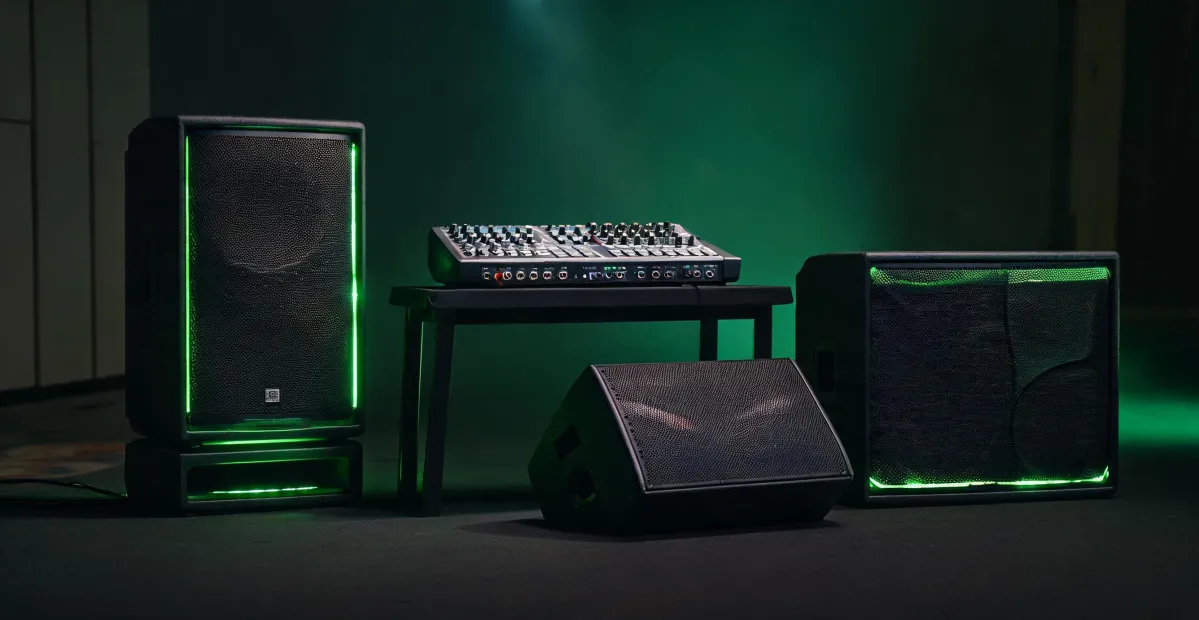
Option A: a portable system built around one or two Mackie Thump GO battery-powered speakers. It’s compact, it has Bluetooth, and it removes power cables from the small-gig equation.
Option B: a modular Mackie active PA system: a pair of larger powered mains, a small digital audio mixer, and whatever stage monitoring and cabling the event requires.
The comparison below is not Mackie versus a competitor. It’s two ways to buy the same brand, and the total-cost math comes out differently depending on your jobs.
Dimension 1: Setup time is real money
At a park event in June 2024, we booked a modular system for a speaking program. The site map showed power at the stage. The stage was next to a picnic shelter, and that shelter’s breaker was shared with the food vendor. Two or three times, a coffee urn or a refrigerator killed the audio circuit. We worked around it, but the crew time went up.
That same day, we had brought a Mackie Thump GO for the check-in table. It was the only speaker on site that did not depend on an outlet. We moved it to the stage, connected the host mic, and the schedule stayed on time.
That event changed how I estimate small jobs. A battery speaker is not a convenience. It’s labor insurance.
Compare that with the modular route. When a crew member has to run extension cables, find a circuit, or build a power distro just for a two-hour presentation, you are paying setup time that does not make the sound better. Given our crew rate, that labor shows up on the next invoice.
Bottom line on this dimension: if your events are small and the venue power is uncertain, the Thump GO route often wins before you even compare speaker specifications.
Dimension 2: Coverage and honest expectations
I’m not going to pretend a compact battery speaker covers what a full PA covers. It doesn’t. A 150-person wedding with a live band is not a Thump GO job. A full Mackie active PA system with powered mains, probably a subwoofer, and a real mixer is the right tool when you need to move air and control feedback.
What the GO does well is spoken word, acoustic sets, and light corporate playback. We have used it for award ceremonies, podcast stages, and side rooms that used to get a full system out of habit. In each case, the sound was clear enough, and the client did not care that they saw a single compact speaker.
So this dimension has a clear winner. Option B wins for reach and SPL. Option A wins for the jobs where the old system was overbuilt.
Dimension 3: The stage monitor box phrase is a flag
I learned this one from a rider mistake.
Our production manager read a band rider that said monitor. I approved it as a stage monitor box. Their tour manager meant in-ear monitors. We loaded a wedge that never left the van and left behind a splitter that the in-ear rack needed. That communication failure cost us time on site, but the lesson was useful.
A stage monitor box is a component, not a feature of every PA. The modular Mackie active PA system route gives you room for that request because the mixer has aux sends and you can plug a powered wedge into a separate output. The portable route does not. It is designed for simplicity, not for a monitor-heavy production rider.
If your calendar includes many bands with riders, buy the modular system and buy a real monitor. If your calendar is corporate and acoustic, skip the monitor box until someone asks for it by name.
Dimension 4: Audio mixer, online events, and the workflow shift
In 2022, our stream setup was slow. We had a small analog console, an external USB interface, and enough extra cables to make every patch feel like a puzzle. Adding music to an online event meant two people: one to ride the faders and one to press play. It was a process gap that appeared every time.
The fix came from a digital mixer. I bought a Mackie DL-series mixer for our main PA because it had USB streaming built in. That one change shifted our production from two people on the computer to one. The same board sends audio to the room and to the caller. When a client wants to add a recorded track to their online event, the signal flow is simple.
Some people search for an audio mixer online add music arrangement when they mean a board that can feed a recorded track into a live stream. That search phrase sounds awkward, but the requirement is real. A digital mixer with a USB audio interface answers it.
For a portable gig, the Thump GO’s Bluetooth input offers a smaller version of that convenience. No mixer, no interface, no USB cable — just a phone and the speaker. That is efficiency, and efficiency is a competitive advantage when you invoice per hour.
Mackie Thump GO price: the number everyone asks about
As of March 2025, three online dealers I checked listed the Mackie Thump GO between $299.99 and $349.99. Prices move with sales and bundles, so verify current pricing before you use this number in a proposal.
That price range matters because it is close to our blended crew-and-vehicle rate for one small event. If this speaker removes one hour of power troubleshooting, it has already paid most of its cost. If it removes a second setup call, the TCO story gets even better.
Price is what you pay on the invoice. Cost is what you pay when the system shows up late, loses power, or does not match the rider.
For a full modular system, I do not quote a single price. The realistic range depends on your mixer choice, subwoofer size, and cable inventory. The comparison is not about which option is cheaper on paper; it is about which one matches the jobs you actually book.
So which Mackie active PA system should you buy?
When I audited our 2023 spending, I found that about 18% of our sound-related budget overruns came from overbuilding small events. We sent a full system, two crew members, and a pile of cables to jobs that a battery-powered speaker could handle. We now start the planning call with a simpler question: how many people are in the room, and what do they need to hear?
The answer is not either/or for my company. We added a Thump GO and kept the modular system. But if I were stocking a new inventory, I would decide based on your calendar:
- Choose the Thump GO portable route if most of your events are under 60 people, power access is unreliable, or you need a backup speaker that can work anywhere.
- Choose the full Mackie active PA system if you serve bands, larger audiences, or clients who expect a stage monitor setup and rider capability.
Do not buy a system based on one headline spec. Look at the labor it saves, the venues it fits, and the invoices it can prevent. That is how you make audio procurement boring.

Elise Marceau
Elise Marceau is an LED display and digital-signage systems analyst covering LED video walls, modular screens, transparent LED, control processors, and indoor or outdoor signage. She applies IEC 62368-1 safety principles while comparing pixel pitch, luminance, contrast, refresh rate, colour uniformity, viewing angle, ingress protection, power density, module serviceability, and signal redundancy. Her specification guides help integrators, venue operators, retailers, and procurement teams align viewing distance, ambient light, content format, installation access, electrical load, and lifecycle support.