Buying a Mackie PA for Work Events: An Office Buyer's Honest Guide to Thump12A and DL16S
-
The surface problem: too many specs and no context
-
The deeper issue: spec sheets describe components, not outcomes
-
My wrong assumption about the "right" amount of gear
-
The real cost of audio mistakes is not the hardware
-
What I would do again: a simple, mobile company PA
-
Honest limitation: when this advice does not apply
-
If you are the admin buyer: start with constraints, not specs
Two years ago, if you told me I would spend a week researching powered loudspeakers, I would have laughed. I am not an audio engineer. I am the office administrator who handles purchasing for a 200-person company, which means roughly 60 to 80 orders a year. Most of those orders are the exciting stuff: chairs, displays, catering. But when our quarterly town hall sound started failing, the "find a decent PA" project landed on my desk. This is not a product review. It is a procurement lesson.
The surface problem: too many specs and no context
My first search looked simple. I typed "Mackie 12-inch powered loudspeaker Thump12A" because a colleague mentioned that Mackie speakers are common in rental and corporate AV. The price seemed reasonable. Then I searched for "Mackie DL16S price" because an events person suggested we buy a digital mixer with room to grow.
That is where the process broke. The search results mixed different categories into one pile. One page showed a category labeled "IRA speaker PA." Another proposal from an AV vendor included a "MI347 7-channel power amplifier." All of them are audio products. They are not the same type of system, and comparing them on paper made me feel smart without making me informed.
I assumed that because I could buy office AV equipment successfully, audio would be similar. It was not. Huddle-room cameras are simple, self-contained products. A PA system is a small ecosystem: speakers, a mixer, microphones, cables, loudspeaker placement, and someone who can run it.
The deeper issue: spec sheets describe components, not outcomes
The first deeper issue is that a 12-inch powered loudspeaker is a component statement, not a coverage statement. A Mackie Thump12A may be perfect in a small banquet room and weak in a boomy auditorium. That is not a contradiction. It means the real questions were about room size, placement, and speech intelligibility, not the wattage figure.
I did not know that at first. I almost compared wattages, weight, input count, and Bluetooth as if they all mattered equally. In reality, the make-or-break inputs for my use case were much narrower: Does it accept a microphone mixer output? Does it fit on the speaker stands we own? Can a staff member set it up in 20 minutes?
More often than not, the answer was about people, not product. We had one well-meaning employee who thought placing a speaker behind a presenter was fine. That placement ruins intelligibility no matter how good the powered speaker is. No spec sheet catches that.
My wrong assumption about the "right" amount of gear
Here is where I need to be honest. I nearly bought too much.
A digital mixer with 16 inputs sounds future-proof. I looked at the Mackie DL16S and pictured our office finally being ready for a real stage setup. But our actual event needed two handheld microphones, one laptop, and an occasional podium mic. That is not a 16-channel job. The DL16S price is easy to justify only if you will actually use its wireless stagebox or multi-input flexibility.
The same happened with amplifiers. An integrator quote included a "MI347 7-channel power amplifier." That line item looks authoritative, but it only makes sense when you have passive speakers and a fixed installed sound system. We did not. We needed powered speakers with a small mixer for portable audio, not a rack full of channels we had no speakers for.
That was my wake-up moment: I was choosing categories before I understood the workflow. I said "portable PA." The vendor heard "installed system." We were using the same words but meaning different things. Misunderstandings like that go straight to the budget.
The real cost of audio mistakes is not the hardware
If I make a bad office chair purchase, finance gets unhappy and we send it back. When audio fails in front of 150 employees, the cost is different. There is the obvious cost of last-minute rentals and return shipping. There is also the quieter cost of trust.
After the 2022 town hall, when the conference room sound cut out during a leadership update, we stopped the meeting for 10 minutes. Nobody blamed the room acoustics. They blamed whoever bought the system. I had inherited equipment, but I still owned the outcome. Ever since then, I have treated audio purchases like vendor management: check the invoice control, confirm setup requirements, and identify who will support it.
That might sound like overthinking for a pair of loudspeakers. It is not. A vendor that cannot provide a clean itemized quote became a problem for our accounting team once, and I now verify that before ordering any equipment. The lowest quote is rarely the lowest total cost once rush shipping, extra cables, and a second support phone call appear.
What I would do again: a simple, mobile company PA
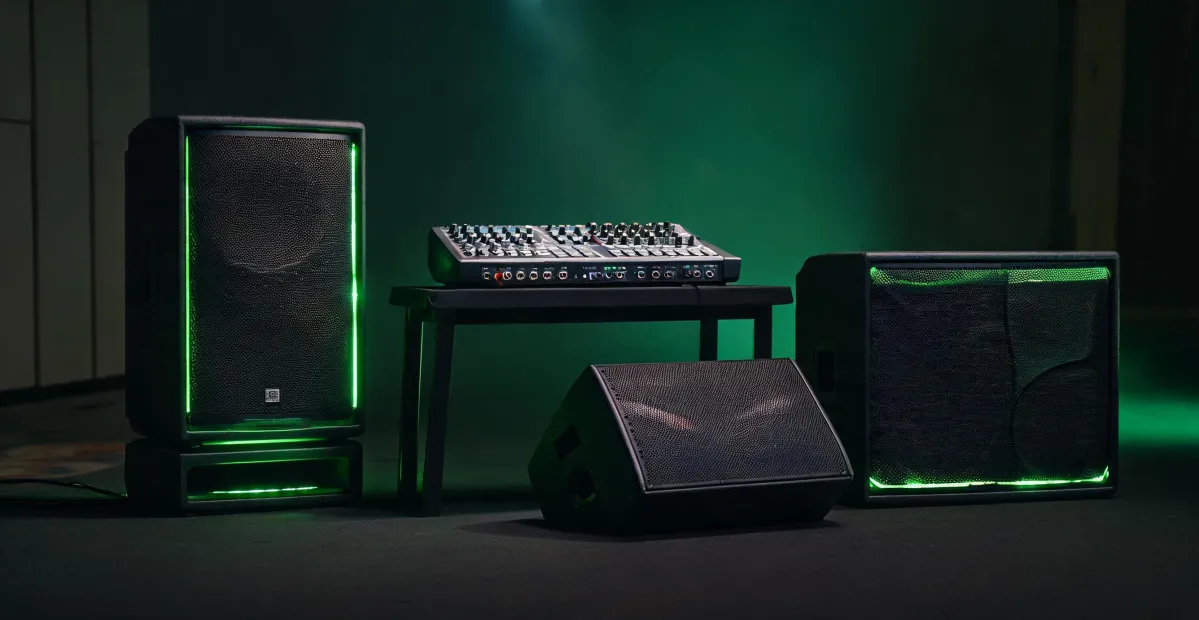
For our situation, the right answer ended up being two Mackie 12-inch powered loudspeakers Thump12A on stands, a compact mixer for our portable audio needs, and proper microphone cables. I recommend this type of setup for lots of internal office applications:
- Presentations and town halls where speech clarity matters more than loudness.
- Rooms of roughly 50 to 200 people.
- Teams that need to pack the system in a cart and move it between locations.
A compact powered speaker with a built-in amplifier removes the hardest part of matching separate amps and passive speakers. Pairing it with a small mixer gives two microphones and a laptop a predictable signal path. The Mackie ecosystem made sense because it covers the speakers and mixers we needed without forcing us into a fixed installation.
Honest limitation: when this advice does not apply
I would not buy the same system for every company. If your venue is fixed and has built-in passive speakers distributed across many zones, you might need the MI347-style amplifier and an integrator. If your events are outdoor festivals or music-heavy stages, compact 12-inch powered speakers will be out of their depth. That is not a flaw in the product; it is a mismatch between the product and the problem.
I also would not order the DL16S just because its price appears in a sale. If your staff does not need iPad mixing, multiple aux sends, or more than a few inputs, the feature cost is wasted. And if you are looking at a system designed for an "IRA speaker PA" style installation, ask what that means before you approve it. A line item is not a plan.
If you are the admin buyer: start with constraints, not specs
What changed for me was answering questions before opening a search window:
- Who will set it up?
- What event is the minimum viable case, not the dream case?
- Does the system have to move, or can it stay in one room?
- Who will replace a cable or reposition a speaker when something sounds wrong?
Mackie products, from the Thump12A powered loudspeaker to the DL16S digital mixer, did well in that review. But they earned the order because the problem was defined first. If someone asks me for the "best" PA now, my honest answer is: the best one is the one you can set up, mic correctly, and find support for when the person who requested it is standing on stage waiting to speak.
That may sound less exciting than a spec comparison. It will save you more than the price difference, though.

Elise Marceau
Elise Marceau is an LED display and digital-signage systems analyst covering LED video walls, modular screens, transparent LED, control processors, and indoor or outdoor signage. She applies IEC 62368-1 safety principles while comparing pixel pitch, luminance, contrast, refresh rate, colour uniformity, viewing angle, ingress protection, power density, module serviceability, and signal redundancy. Her specification guides help integrators, venue operators, retailers, and procurement teams align viewing distance, ambient light, content format, installation access, electrical load, and lifecycle support.