Mackie Thump Go Subwoofer and SRM-Flex Column PA: An 8-Year Rental Veteran's Honest Reviews
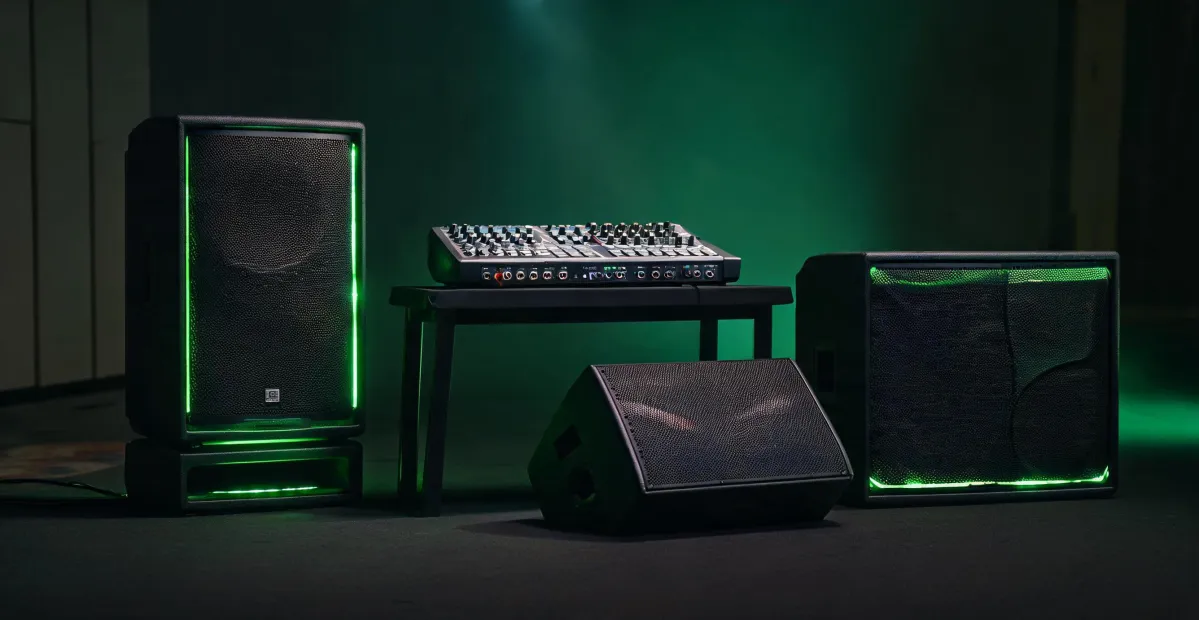
Take this from someone who has burned roughly $28,000 on the wrong audio gear: if you are a small production company or solo act, the Mackie Thump Go subwoofer and SRM-Flex column PA are genuinely good choices—but only if you evaluate them with standard loudspeaker measurements, not the spec sheet wattage. Most buyers focus on watts and completely miss battery life, coverage, and how the system behaves at 50 feet.
How I Learned This the Hard Way
I run a one-rig PA rental company in Cleveland. I've handled rental orders for eight years, and I've personally made (and documented) 14 significant mistakes, totaling roughly $28,000 in wasted budget. This is the embarrassing part I don't usually put on the website.
In my first year, I made the classic specification error: I bought a subwoofer because the max SPL number looked huge. It turned out that number was measured at 1 kHz, not across the low end where a subwoofer actually works. (Ugh.) The system had no bass, and a client demanded a refund. That $600 mistake plus the lost repeat business taught me to ask how a number was measured, not just what the number is.
The 'more watts equals louder' thinking comes from an era before active crossovers and DSP. Today, powered speakers have onboard amps and limiting. That has changed. The loudspeaker paradigm has shifted to measured performance: frequency response with a tolerance, maximum SPL under a standard noise source, and coverage angle.
Mackie Thump Go Subwoofer: Not a Gimmick
I'll be honest: when I first saw the Thump Go subwoofer (the compact, battery-powered sub in Mackie's Thump Go line), I thought it was a toy. I wrote it off as a novelty product until I used one at a farmer's market gig in the summer of 2023. (I know, I was late.)
It's not going to do chest-thumping EDM bass. But for acoustic acts, small ceremonies, and events where you cannot run a cable, it's a real workhorse. It's also the new loudspeaker paradigm in action: battery and portability matter as much as wattage. Small doesn't mean unimportant—it means potential. The same lesson applies to small customers, by the way.
If you're a solo acoustic act or a tiny rental company, this is where the Thump Go subwoofer earns its keep. A generator rental alone can cost more than a day's battery. In my experience, vendors who treated my $200 orders seriously when I started out are the ones I still call for $20,000 orders. Mackie has a similar philosophy: they didn't make a battery sub to impress arena engineers; they made it for the person carrying a PA in a hatchback.
Mackie Portable Column PA System SRM-Flex Reviews: What They Usually Don't Say
Search for 'Mackie portable column PA system SRM-Flex reviews' and you'll see a lot of 'it's good for speech, fine for acoustic.' That's accurate, but it misses the part that matters for a small rental company: it is forgiving. Setup takes about ten minutes, and the coverage is far more even than a traditional speaker on a stick. I've used it at a 100-person wedding and a 60-person corporate welcome dinner. In both cases, I didn't have to run back to the mixer to fix feedback during the first song. (Finally!)
The SRM-Flex is not a DJ system. If you want to shake walls, rent a line array with subs. But if you need clean, intelligible sound for events where people talk and listen, it's a sensible choice.
Standard Loudspeaker Measurements: The Only Way to Compare
Here is where I used to get burned. Spec sheets show '1000W program power' or '120 dB max SPL,' but there is no universal law forcing every brand to measure them the same way. Standard loudspeaker measurements exist, but a good portion of marketing still doesn't tell you the measurement condition.
What to look for in standard loudspeaker measurements:
- Frequency response with a tolerance, like 50 Hz to 20 kHz at +/-3 dB. That is a real spec. A number with no tolerance tells you nothing.
- Maximum SPL measured with a standard noise source, not a 1 kHz tone.
- Directivity or coverage angle, if available.
- Subwoofer output per CEA-2010, which is far more honest than 'peak watts.'
This is why I bought a UMIK-1 measurement mic (cheap, maybe $100) and started measuring every speaker before I buy. It has saved me from another $2,000 mistake. If you plan to buy a Mackie Thump Go subwoofer or any powered PA, take a look at the measured response, not just the marketing sheet.
What About the Seachoice 1000W Marine Power Amplifier?
You might be reading this because you also searched for a marine amplifier. The Seachoice 1000W marine power amplifier is not a PA speaker amplifier. It's a 12V marine stereo amp for boats. I was once asked if it could power a pair of Mackie SRM speakers. It can't. That's not the right tool.
The '1000W' on that kind of product is almost always peak or PMPO, not continuous RMS. Per FTC guidelines (ftc.gov), advertising claims must be truthful and not misleading, but those rules don't force a single wattage test method. So please don't compare a marine amp's wattage to the output of a powered speaker. It's like comparing a truck's towing capacity to a train's. Both pull things, but they live in different worlds.
If you're wiring a boat, that Seachoice amp might be fine for its intended use. If you're buying a PA for a band or a rental company, ignore it and look at Mackie's powered PA lineup instead.
When I Would Tell You Not to Buy
For honesty: the Thump Go subwoofer is not for dance production. It's not a replacement for an 18-inch sub with real low end. And the SRM-Flex is not a rock band PA. If your main gigs are loud full-band shows, rent or invest in larger gear.
Battery-powered gear is only worth it if you actually use the battery. If you never play a gig without shore power, buy the cheaper non-battery version and spend the savings on a better sub.
One more thing: there are rental companies that ignore small orders because the ticket value is low. That's a mistake. The solo acoustic player with a $400 order might be the same person sending you a $4,000 multi-day quote next year. Taking small orders seriously is not charity—it's building a pipeline. (I wish I'd learned that before I started treating small calls as interruptions.)

Elise Marceau
Elise Marceau is an LED display and digital-signage systems analyst covering LED video walls, modular screens, transparent LED, control processors, and indoor or outdoor signage. She applies IEC 62368-1 safety principles while comparing pixel pitch, luminance, contrast, refresh rate, colour uniformity, viewing angle, ingress protection, power density, module serviceability, and signal redundancy. Her specification guides help integrators, venue operators, retailers, and procurement teams align viewing distance, ambient light, content format, installation access, electrical load, and lifecycle support.