Mackie SRM-Flex Reviews: Portable Column PA System vs Mackie 12 Powered Speakers
I'm the office administrator for a 150-person company. I manage all AV and facilities ordering—roughly $40,000 a year across a dozen vendors. Maybe 13, I'd have to check the system. I report to both operations and finance. I'm not an audio engineer, but I'm the person who gets blamed when the CEO can't hear the presenter.
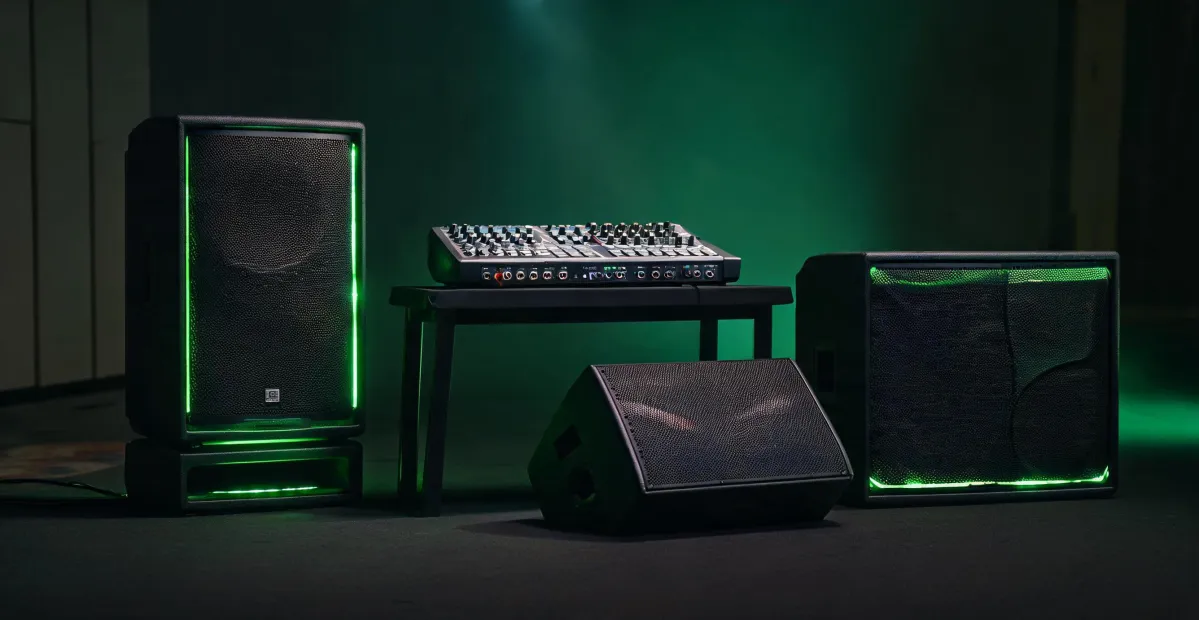
If you're looking for Mackie portable column PA system SRM-Flex reviews, you've probably seen spec-heavy pages. This is the buyer's version. This comparison started because our two aging 12-inch powered speakers needed replacing. I had two Mackie options: the SRM-Flex and a pair of Mackie 12 powered speakers from the Thump/SRM family. I rented both for a week instead of trusting spec sheets.
It's kinda like comparing a rental van with a pickup truck: the right choice depends on what you're hauling. Here's the honest version of what I found.
Setup: Column PA vs Two Speakers on Stands
The SRM-Flex wins on raw setup speed. The sub sits on the floor, the column slides into the top, one cable connects them, then plug it into power. No speaker stands, no pole sockets, no audio snakes. I timed myself: first try, about 12 minutes from case to sound-check. On the second try, under 8.
The 12 powered speakers are not hard, but there are simply more pieces. Two speakers, two stands, two power cables, two signal cables, and if you don't already have a mixer, a mixer. More pieces means more ways for the volunteer AV committee to email me at 7 a.m. with a photo of a cable they can't identify.
Here's the part that surprised me. The column is actually a little awkward to store. The column itself is tall and fragile-looking; the sub is a solid 12-inch cube. The two 12-inch speakers stack neatly on a standard shelf. So if storage space is your real constraint, measure your closet before you fall in love with the column. But if you're setting up and tearing down every week, the column saves you real time.
Verdict for setup: column for speed, traditional speakers for shelving.
Coverage: What 'Total PA Speaker' Really Means
This is the dimension where my gut beat the data. A month earlier, I had about two hours to lock in gear for an all-hands meeting, skipped testing, and spent the first 20 minutes chasing feedback. In hindsight, I should have pushed the decision back a day. This time I didn't.
The spec sheet for the 12-inch speakers showed more raw maximum SPL. The numbers said they would go louder. My gut said the column would cover the room better. I rented both, and my gut was right—in our long, glass-walled training room, the SRM-Flex produced a more even sound at every seat. That's because the column distributes sound from multiple drivers arranged vertically, which gives you wide horizontal coverage and controlled vertical throw. People in the back row didn't get the front-row blast. That's what I mean when I say 'total PA speaker coverage': not just how loud the box can be, but how well the sound reaches the whole room.
To be fair, a pair of 12-inch powered speakers can do something a single column can't do as well: cover a wide, shallow room with left and right separation. For a 60-foot-wide outdoor tent, I'd take two 12-inch speakers on stands over one column in the center. But most of the rooms I buy for are deeper than they are wide. For those, the column is more predictable.
Verdict for coverage: deep/narrow rooms go column; wide/shallow rooms go with two 12-inch speakers.
Power, Microphone Amplifier Power, and the Razer Mixer Trap
Every buyer asks about power. The Mackie SRM-Flex is listed at 2,500 W peak; a Mackie 12 powered speaker like the Thump 12 is listed at 1,300 W peak. Those are Mackie's published numbers as of April 2025—verify them on the product page because specs change between generations. But 'peak' is marketing language. What actually matters for a microphone is usable gain before feedback.
Put another way: 'microphone amplifier power' is not just wattage. It's how much clean gain you can apply to a vocal mic before the room starts howling. The SRM-Flex has a built-in mixer with EQ, effects, and feedback suppression. The 12-inch powered speaker can sound great too, but you'll likely add an external mixer or a feedback eliminator to get the same control. That adds cost and complexity.
Here's a real purchasing lesson from a few years ago. We saved $200 by buying a basic powered speaker instead of one with DSP. Then we spent $600 renting a feedback suppressor and equalizer for two events because the cheap speaker squealed every time a presenter walked in front of it. I still cringe at that math.
And if you've ever searched 'no sound coming from Razer audio mixer' after setting up a PA, you know the real problem is usually the signal chain, not the speakers. I've seen that exact issue in forums: user has a mixer, powered speakers, and silence. The fix is nearly always input routing, a mute button, or a software setting. That's why I value a simple, visible mixer interface. Too many hidden menus, too many things to check at 8 a.m.
Before you get too deep into wattage, remember this: per FTC guidelines (ftc.gov), claims like 'peak power' have to be substantiated. That doesn't make them useful in a real room. It just means I start with published specs and then verify with my ears.
Verdict for power: if your primary job is spoken word, the column system gives you more usable mic gain with less fuss. If you need raw volume for music, the two 12-inch speakers will get louder.
True Cost: The Sticker Price Isn't the Whole Invoice
Let's talk about money from a purchasing perspective. The SRM-Flex has a higher price than one 12-inch powered speaker. That's the thing that scares budget owners. But you're not buying one 12-inch speaker; you're buying a system that can cover a room.
For a pair of 12-inch powered speakers, add two speaker stands, a small mixer, a feedback suppressor if you don't want to chase howl, cables, and possibly a rack. Suddenly the price gap between the column system and the traditional setup is a lot smaller. The SRM-Flex includes the mixer, DSP, effects, feedback suppression, and wireless control in one purchase order.
This is where my purchasing background kicked in. I've learned to ask 'what's NOT included' before 'what's the price.' The vendor who lists all fees upfront—even if the total looks higher—usually costs less in the end. Mackie publishes the SRM-Flex as a complete package. With 12-inch powered speakers, the price is per speaker, and you fill in the rest. I'd rather approve one line item that does the whole job than four line items that might not talk to each other.
Does that mean the SRM-Flex is always the cheaper answer? No. If you already own stands, mixer, and cables, a pair of 12-inch speakers is likely a better investment. But don't compare an all-in-one system to a single speaker. That comparison is rigged from the start.
Verdict for cost: compare complete systems, not individual speakers. Transparency about what's included is worth money.
Flexibility: The Case for Keeping It Modular
The 12-inch powered speakers are more flexible in one important sense. They're modular. Use one as a floor monitor for a band, use two as mains for a small stage, add a third for an overflow room. If one speaker stops working, the other still covers you while you figure out service. Rental houses and AV integrators speak this language.
The SRM-Flex is a system, not a pile of interchangeable boxes. It sounds better in the room it's designed for, but you can't turn the sub into a floor monitor or take the column apart for side fills. If a component fails, the whole system is out of action until that component comes back. For a company that rents AV gear or runs different configurations every week, that's a real limitation.
For our fixed training room, the column's lack of modularity didn't matter. For a warehouse, an outdoor tent, or ad hoc breakout rooms, the old pair of 12-inch speakers is more useful. That's why I'd argue for both if the budget allows—but if you can only pick one, decide based on your actual schedule, not on flexibility that you'll never use.
Verdict for flexibility: rental/production culture should choose 12-inch speakers; fixed in-house rooms can go column.
Which Should You Buy?
Here's the honest recommendation for a company like mine.
Buy the Mackie SRM-Flex if:
- You have one main room for meetings and training.
- Most content is spoken word with a wireless mic.
- Non-experts will set it up.
- You want one transparent purchase order with no hidden extras.
Buy Mackie 12 powered speakers if:
- You need floor monitors or left-right mains for a stage.
- You already own stands, mixers, and cables.
- You work with rental crews who expect standard boxes.
- Your space is wide and shallow.
We ended up ordering the SRM-Flex for the training center. I still kept the old 12-inch pair for the loading dock and outdoor events. If I had to choose one for a 150-person office, I'd choose the column. But I get why someone in a different situation would go the other way. The point is to buy the system that gives you clean mic gain, even coverage, and no surprise charges.

Elise Marceau
Elise Marceau is an LED display and digital-signage systems analyst covering LED video walls, modular screens, transparent LED, control processors, and indoor or outdoor signage. She applies IEC 62368-1 safety principles while comparing pixel pitch, luminance, contrast, refresh rate, colour uniformity, viewing angle, ingress protection, power density, module serviceability, and signal redundancy. Her specification guides help integrators, venue operators, retailers, and procurement teams align viewing distance, ambient light, content format, installation access, electrical load, and lifecycle support.