Mackie Array Speakers and PA Systems: A Rental Production Manager's Honest Guide
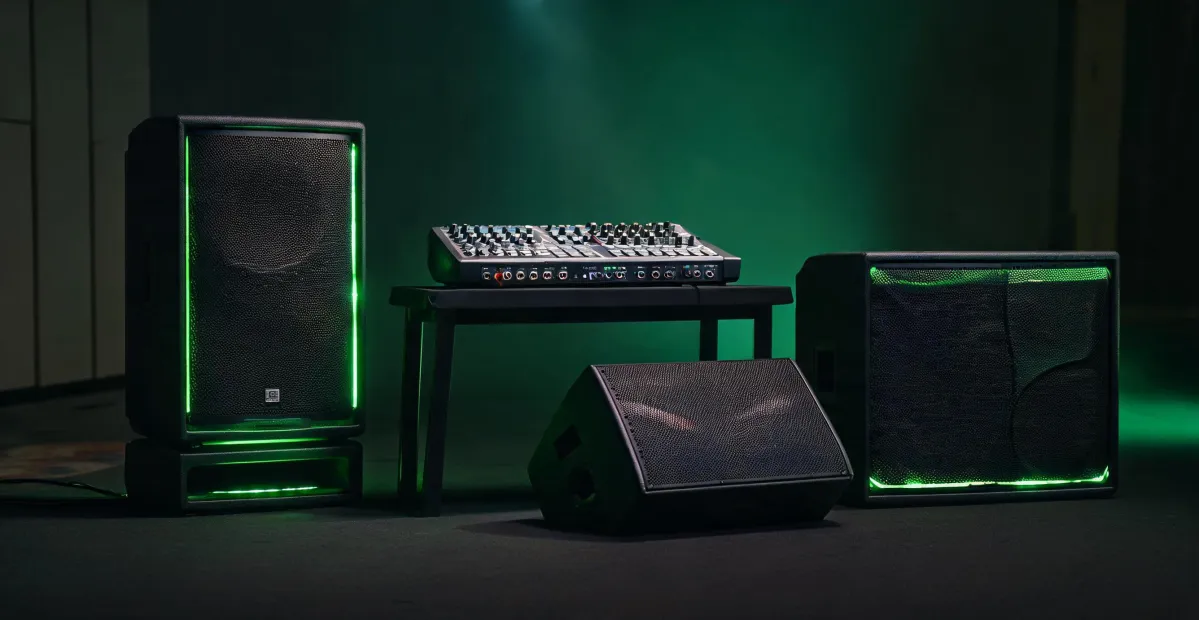
If you're putting together a Mackie PA system for a small or mid-size event, here's the short version: use powered Mackie speakers, one sub, and a USB audio mixer. That covers roughly 80% of the rental jobs I coordinate. Skip the passive cabinet and separate power amp until you know you need a permanent install. And if you're wondering about Mackie array speakers, hold on. Most venues don't need an actual line array.
In my role coordinating audio for an AV rental company, I've handled 200+ rush setups in the last twelve years. In March 2024, a client called at 9 PM needing a full PA for a conference room by noon the next day. Normal turnaround is two business days. We pulled a pair of powered Mackie speakers from storage, added a sub, and delivered at 10 AM (which, honestly, is faster than most quotes I see). Missing that deadline would have meant a $50,000 penalty clause. That's why I default to gear that sets up fast. When I'm triaging a rush order, I ask three things: hours left, can the gear get there, and what breaks if we're late. In that order.
In my opinion, the extra cost of a sub is worth it. Bass makes a room feel bigger than any upgrade on the top boxes. Not every budget allows it, but if you can stretch, stretch for the sub.
Why Listen to Me (and Where I Stop Listening)
I've tested different options in the field, not in a demo room. After 3 failed rush orders with discount vendors, we standardized on a few Mackie models because they're easy to deploy and the spec sheets are honest. Not because they're the only good brand. If you do the same job with QSC, JBL, or Electro-Voice, you're not wrong. But for my clients' budgets, Mackie keeps the show going.
My experience is based on about 200 mid-range rental jobs. If you're working in arenas or touring festivals, this doesn't apply. If you're an installed-sound contractor, you'll care more about fixed speakers and coverage modeling. Take what works for your context.
What Is a USB Audio Mixer?
A USB audio mixer is a mixer with a built-in USB audio interface. It sends the main mix to a computer for recording, livestreaming, or virtual soundcheck, and it can return audio from the computer for intermission playback. For most small events, that's enough.
Why do I care in a rental context? It removes one box from the signal chain. Instead of carrying a mixer, a separate interface, and the cables that connect them, you carry one Mackie ProFX mixer and a USB cable. That's it.
One mistake I made early on: I assumed any 8-channel mixer would work for a podcast event because the spec sheet said “mixer.” It didn't have USB out. We found out when we couldn't connect to the venue's recording laptop. Now I ask specifically: Does it have USB out? Is it class-compliant? Not ideal, but workable after one trip back to the shop.
Mixing in a Rack: Mixer Audio Rack Basics
When clients ask about a mixer audio rack setup, they usually mean a shallow rack drawer with a mixer and maybe a wireless receiver. The first time I bought cheap rack ears that didn't fit. Learn from my frustration: check the mixer's manual for the exact rack kit.
Mackie's small VLZ series has rack-mount options, and the ProFX line gives you USB output in a compact mixer that can live in a rack drawer or on a shelf. Measure the rack rails and leave a few inches behind for USB and power cables. A deep mixer or stiff cable can be the difference between a clean patch and a mess.
One more thing: cooling. Racks get hot, especially if a power amplifier sits in the same rack. The reason powered speakers won for us is that you don't need to rack the amp at all.
Mackie Array Speakers: The Part Most People Skip
Here's the uncomfortable truth about Mackie array speakers: most people searching for them don't need an array. They need speakers that can throw farther than a typical wedge. A real line array matters when you need vertical coverage control, not just volume. If the room is 300 seats and you're on the ground, a couple of powered 12s on poles will cover it better than a poorly deployed array.
That said, the array-capable Mackie options are legit. I've used arrayable DLM boxes with their mounting hardware for a 400-person corporate presentation. They rig faster than a traditional PA, and the vertical coverage was consistent. But the moment you start flying boxes, you're no longer in “speaker on a pole” territory. You need rigging points, load calculations, and a plan for element angles.
Communication example: I told a client I'd bring a line array system. He heard “any tall speaker on a stick.” We discovered this when we arrived and the venue had no rigging points. I brought array boxes anyway. Simple. We rented crank stands. Exactly what was needed.
Power Amplifier News That Matters for Small Operators
The power amplifier news since 2020 is simple: Class-D wins. It's light, efficient, and good enough for live sound. That's why Mackie PA systems like the DRM series are powered with onboard amplifiers. For the rental market, this means you can carry a “system” without a separate amp rack. It's kind of amazing that a 1000W speaker weighs less than a 500W amp used to weigh.
One thing to check on any spec sheet: whether the wattage is peak or continuous. A $300 speaker rated “2000W peak” isn't the same as an $800 speaker rated “2000W continuous.” Mackie publishes these numbers openly (check mackie.com), but not every brand does. If a quote only lists peak watts, ask.
Small Orders Don't Scare Me
I'll be direct: I've had salespeople ignore me when I was buying one speaker. That's short-sighted. My first Mackie order was about $200 worth of adapters and a used mixer. A few years later, my company was authorizing $20,000 purchases. The vendors who treated the $200 order with respect are the ones I still call.
Small doesn't mean unimportant — it means potential.
If you're a small band, a church, or a freelancer building a PA one piece at a time, you're the kind of customer I like working with. Mackie's range is wide enough that you can start with one powered box and add a second later. That's a feature, not a compromise.
When This Advice Doesn't Apply
My experience is based on mid-size rental and live-sound jobs. If you're installing a fixed system, you'll need better coverage modeling than this article. If you're touring international festivals, you'll likely spec premium arrays with more horsepower. And if you're just buying studio monitors for a home setup, that's a different conversation.
Bottom line: start with a straightforward Mackie powered system, add a sub, and use a USB mixer. See if it solves your real problem before you chase array speakers and amplifier racks. Done.

Elise Marceau
Elise Marceau is an LED display and digital-signage systems analyst covering LED video walls, modular screens, transparent LED, control processors, and indoor or outdoor signage. She applies IEC 62368-1 safety principles while comparing pixel pitch, luminance, contrast, refresh rate, colour uniformity, viewing angle, ingress protection, power density, module serviceability, and signal redundancy. Her specification guides help integrators, venue operators, retailers, and procurement teams align viewing distance, ambient light, content format, installation access, electrical load, and lifecycle support.