Mackie 15-Inch Powered Speakers vs. JB Systems PSA-15: A Buyer's Comparison for Portable PA
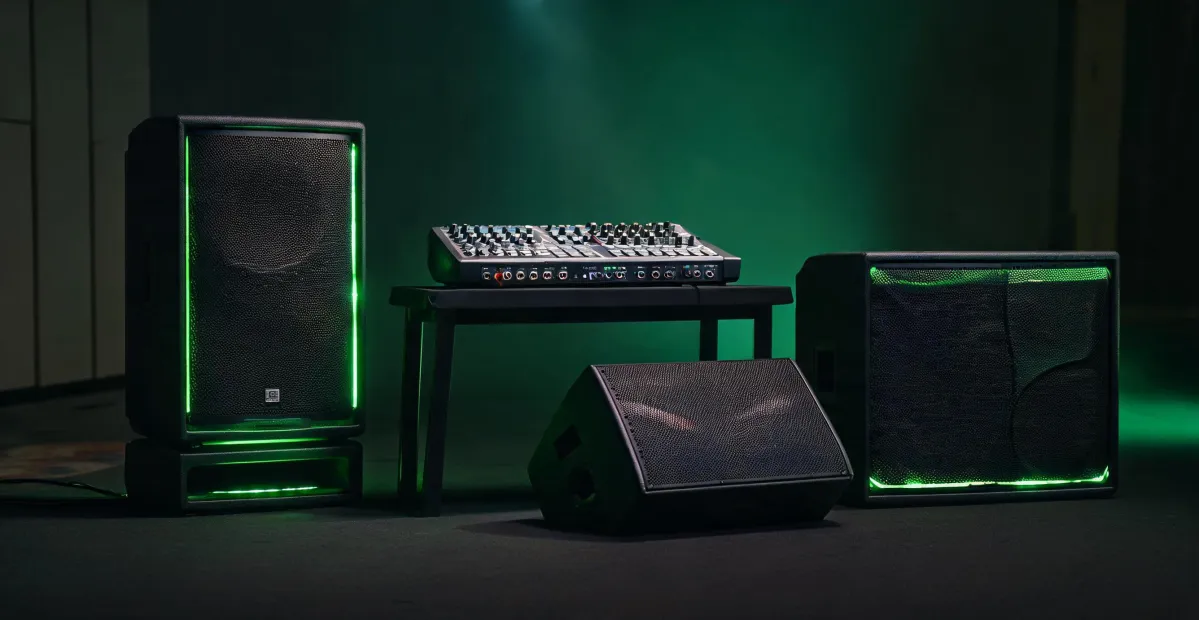
If you're responsible for outfitting a venue, rental inventory, or a corporate event space, the choice between Mackie 15-inch powered speakers and the JB Systems PSA-15 portable active loudspeaker isn't just a spec-sheet exercise. It's a bet on uptime, training load, and how many times you'll have to apologize to a sound engineer. I've been managing equipment purchases for a mid-sized AV rental department since 2020, and this comparison is the one I keep coming back to.
Why I'm Comparing These Two
In our 2024 vendor consolidation project, we needed speakers that could do double duty: standing in for floor monitors at small corporate shows and covering amplified panels for 150 to 300 people. The Mackie 15-inch powered speakers were an obvious candidate because we already owned a pair of Mackie Thump15s. The JB Systems PSA-15 kept coming up in quotes from a regional supplier, usually at a lower price point. So I spent a few weeks with both, and this is the breakdown.
My initial assumption was that price alone would settle it. The JB Systems PSA-15 is often cheaper upfront, and I almost ordered ten units before our August event. Then a subwoofer compatibility issue and a dead-on-arrival unit changed my mind. Now I care more about total cost and confidence.
Dimension 1: Sound Quality and Coverage
For spoken word and background music, the JB Systems PSA-15 is honestly fine. It produces a clean midrange and doesn't get harsh at moderate levels. But when you push a PSA-15 outdoors or ask it to cover a live band, the limitations show. The Mackie 15-inch powered speakers, especially the SRM215, have noticeably more headroom and a better-defined low end. That extra headroom is exactly what prevents the 'ripped speaker' call at the end of the night.
I'm comparing behavior in practical conditions, not lab measurements. In our experience, the PSA-15 started to sound compressed at around 85% of its maximum output, while the Mackie stayed clean to a higher level. If you're planning to pair with a subwoofer—say an SHCA subwoofer that a client sometimes supplies—the Mackie's crossover points cooperate better. The PSA-15's simple input section works, but you'll spend more time setting gain structure.
That's a clear conclusion: the Mackie is the safer choice for demanding gigs, and the JB Systems unit is the budget choice for gentle duty.
Dimension 2: Portability and Setup Speed
Both have handles and are relatively transportable, but the Mackie 15-inch cabinets are heavier. The SRM215 is not something I enjoy carrying up stairs—or rather, it's tolerable but my back disagrees. The JB Systems PSA-15 is lighter and roughly fits into a small hatchback, which is a real advantage for a one-person setup.
Here's the part that surprised me. The PSA-15 looks easier to move on paper, but after a full day of load-ins, the Mackie's top handles and balanced weight distribution actually felt more controlled. The PSA-15's side handles put extra pressure on my wrists. So while the scale says Mackie is heavier, the carrying feel is better designed.
Also, Mackie has a backup option that changes the conversation: the Thump GO. It's not a 15-inch speaker—it's a battery-powered compact PA—but its price matters. The Mackie Thump GO price sits around $399 to $449 depending on the dealer, and it's changed how we handle off-site meetings. We bring a Thump GO instead of a full 15-inch system for small breakouts. It's not a replacement for a 15-inch speaker, but it means the heavy 15-inch Mackie only comes out when the event actually calls for it.
So the trade-off is: JB Systems wins on raw weight, Mackie wins on ergonomic design and scalable backup.
Dimension 3: Connectivity and Digital Control
This is where the PSA-15 falls behind for our use case. The JB Systems unit has XLR and a basic preamp; that's enough for a simple mic-and-music event. The Mackie 15-inch powered speakers can be paired with a web audio mixer, either a hardware mixer from Mackie's DL series or a software-based virtual rack. Using a web audio mixer gives me the ability to adjust EQ from my phone while I stand in the middle of the room. That feature alone has saved us from feedback issues twice already.
From a buyer's perspective, it's not just about the speakers themselves. If you already run a web audio mixer, staying within the Mackie family means less cabling and less training for A/V staff. The PSA-15 requires an external mixer for anything beyond the simplest input, and that external mixer adds cost and another point of failure.
I should add that not every venue needs digital control. If your setup is one mic and one laptop, the simplicity of the PSA-15 is an advantage. But for multi-speaker events, the web-based control on the Mackie side is worth the extra money.
Dimension 4: Price and Long-Term Cost
Let's talk numbers. Based on dealer quotes I received in Q1 2025, the JB Systems PSA-15 is often $350 to $450 per speaker. The Mackie 15-inch powered speakers range from about $499 for a Thump15 to $799 for an SRM215 (verify current pricing; these fluctuate). That's a meaningful difference when you're buying six or eight units.
But price before purchase is not the whole story. The prevention-over-cure principle applies here: 5 minutes of verifying specs saves days of shipping units back. In our case, a batch of budget speakers caused a subwoofer integration headache that took two technicians a full afternoon to solve. That labor cost erased the upfront savings. I'm not 100% sure every JB Systems unit will have the same issue, but the risk is there.
Also consider the Mackie Thump GO price separately. It's a different category, but if you need a quick backup, the Thump GO can be cheaper than renting a second mixer or speaker for a single event. And if you're adding a sealed subwoofer to the system, the crossover consistency on the Mackie side saves setup time.
One more note: I want to say the PSA-15 was around $380 in our last quote, but don't hold me to that exact number. Street pricing varies by region.
Pre-Purchase Check: A Buyer's Checklist
When I compare two PA systems now, I ask four questions:
- Does the speaker handle the expected SPL without clipping? Check the max SPL spec and whether the limiter kicks in early.
- Can I get replacement parts and support locally? Mackie has a broader service network in most regions; JB Systems availability depends on your distributor.
- Is the input section flexible enough for today's mixers and laptops?
- Will the subwoofer pair correctly? For instance, if a client brings an SHCA subwoofer, can I integrate it without a separate crossover?
I've made the mistake of skipping these checks. The result was a $2,400 expense for a rushed replacement unit and lost staff time. Most of that could have been caught with a quick call to the vendor. The 12-point checklist I created after my third mistake has saved us an estimated $8,000 in potential rework.
Final Recommendation: Which Should You Buy?
If I had to pick for my own equipment list, I'd choose the Mackie 15-inch powered speakers for any serious, repeatable event work. The consistency, headroom, and digital integration make it the lowest total-cost option for us, even at a higher sticker price.
If you're equipping a small venue where the PA will never get pushed hard, or you need a lightweight speaker to carry daily between classrooms, the JB Systems PSA-15 is a legitimate choice. Just verify the warranty and test it before you buy ten.
And if you just need a portable backup or a small-meeting PA, the Mackie Thump GO is a smart addition, not a substitute for a 15-inch speaker. I'd pair it with a proper subwoofer for music-heavy events.
Honestly, I'm not sure how JB Systems support will look in five years. My best guess is Mackie's larger dealer network will make it easier to source parts, but that's a personal opinion, not a guarantee. My experience is based on about 30 events with these speakers. If you're installing them permanently or you need line arrays for large crowds, your priorities will be different.
No single speaker is right for every room. But knowing which one fits which job is half the battle—the other half is checking the details before you sign the purchase order.

Elise Marceau
Elise Marceau is an LED display and digital-signage systems analyst covering LED video walls, modular screens, transparent LED, control processors, and indoor or outdoor signage. She applies IEC 62368-1 safety principles while comparing pixel pitch, luminance, contrast, refresh rate, colour uniformity, viewing angle, ingress protection, power density, module serviceability, and signal redundancy. Her specification guides help integrators, venue operators, retailers, and procurement teams align viewing distance, ambient light, content format, installation access, electrical load, and lifecycle support.