How to Spec a Budget PA: Used Mackie Thump12A, Passive DRM215-P, and the Right Amp
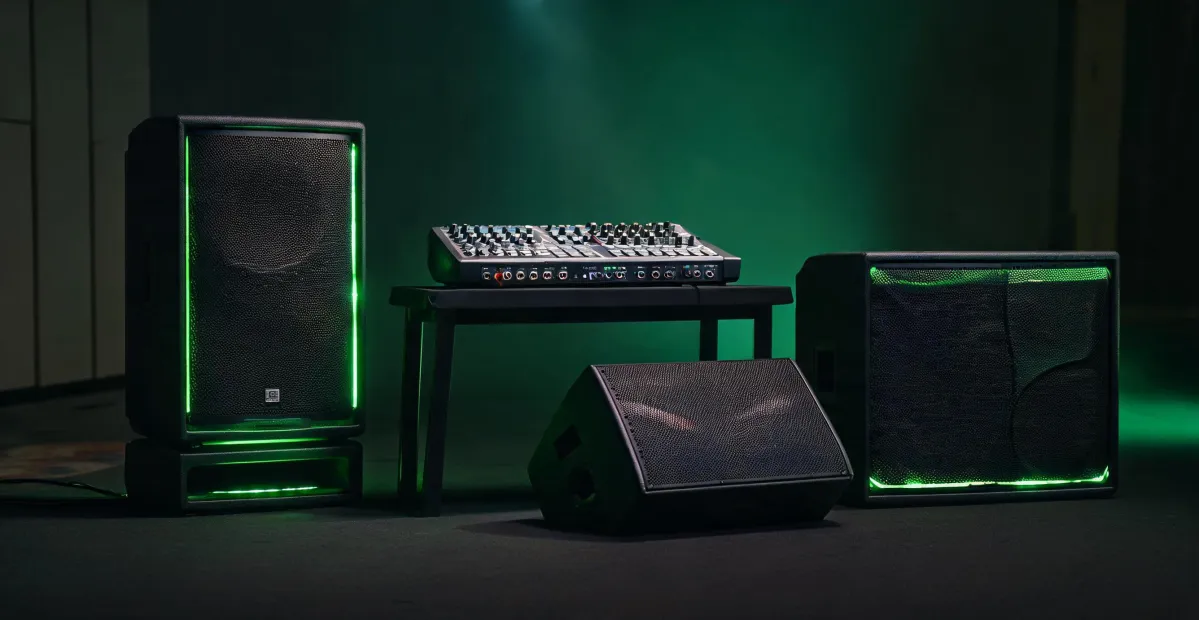
I get asked a lot about building budget PA systems. And I'll be honest—when I see a shopping cart with a used Mackie Thump12A, a Mackie DRM215-P passive loudspeaker, a Power Acoustik RZR4-1500D amplifier, and a bunch of PA accessories in it, I get a little nervous. It looks like a great deal on paper, but the right choice depends entirely on your situation. There's no one-size-fits-all solution in pro audio.
In my role coordinating audio for a regional production company, I've had to triage these exact scenarios. Are you a mobile DJ needing a quick PA? Are you an AV installer bolting speakers to a wall? Or are you a rental house trying to maximize versatility? Let's walk through the branches.
The 'Need It Working by Friday' Scenario (Portable PA)
If you need to move sound from point A to point B, and you need to do it fast, the used Thump12A makes sense. It's powered, which means a non-technical person can set it up. There's no amplifier rack to wire, no crossover to configure. Hook up a microphone, plug it in, and you're done.
That's why used Thump12As are everywhere. People buy them for a wedding, decide they don't need them, and sell them. But—and this is a big but—there's a reason they're on the used market.
I made the classic rookie mistake in my first year: I bought a 'gently used' powered speaker without thoroughly testing it. It looked perfect, but the fan was seized. We didn't catch it until we powered it on in front of a client (surprise, surprise). The thermal cutoff kicked in after ten minutes. We paid a $120 repair fee, but the untested purchase cost us a late night and a very angry venue manager.
If you go the used route, bring a cable and a music source. Crank it. Does the high-frequency driver sound clear, or does it sound like a distorted mess? Put your hand near the rear heat sink. Does the fan spin up smoothly? But here's the other point about the used Thump: since it's a powered speaker, you don't exactly have a slot for that RZR4-1500D amp.
What About The Power Acoustik RZR4-1500D Amp?
The Power Acoustik RZR4-1500D is a 4-channel car audio amplifier. I do not say that to sound snobby—I know budget amp brands are important to get the job done. But this specific amplifier is designed to run car audio speakers, not necessarily a PA rack. The '1500' rating is max power, not RMS. If you bridge two channels to run one pair of passive speakers, you're looking at significantly less clean power.
Let's use the DRM215-P as the example. It's a dual-15 passives with a beefy 2,000-watt peak rating. But continuous power handling is around 500 watts RMS. So you need an amp that delivers a solid 500–800 watts RMS per channel at 8 ohms. A 4-channel car amp bridged to 2 channels might give you enough power on paper, but it might also be current-hungry and unreliable when driven hard.
I've tested six different budget amp setups over the years. The cheap route only saves you money if it doesn't clip. A clipped signal is what actually blows high-frequency drivers. In my experience managing over 200 installations, the lowest-quote amplifier has cost us more time in service calls than any other single component. That $300 amp turns into a $700 drywall repair and a recone fee.
The 'Set It and Forget It' Scenario (Permanent Installation)
Now, if you're an AV installer, a church sound guy, or a bar owner mounting speakers to a wall, I would steer you differently. The Mackie DRM215-P passive loudspeaker is a workhorse for this. Because it's passive, you don't need to run power to the speaker location. You just run speaker cable, cleanly, from a protected amp rack.
When you're suddenly in the world of passive speakers, the amplifier and speaker need to be matched carefully. For a dual-15, you have to consider the impedance. Most DRM215-P models are 8-ohm nominal. If the RZR4-1500D's rating at 4 ohms is what you're based on, you're looking at a mismatch. If you drive a dual-15 with too little clean power, the amp clips, and the tweeters will be the first to tell you—by shutting up permanently.
Your 'surface mount loudspeaker' search also matters here. The DRM215-P is heavy. You don't simply screw a bracket into a single sheet of drywall. You need proper mounting hardware and, ideally, a certified rigging point. We use flyware rated for the weight plus a 2:1 safety margin. I had to walk a client through this last March when they wanted a 'quick' gym install. Missing that deadline would have meant a contractual penalty, but we held the line on proper mounting, which saved them from a potential liability disaster.
A Quick Word on PA Speaker Accessories
PA speaker accessories are where the hidden costs eat you alive. A cheap speaker stand that wobbles is a liability. We once watched a $600 speaker fall off a $39 stand in a school gymnasium—luckily no one was hurt, but the speaker didn't survive. Spend the money on durable stands with the correct speaker pole top hat size.
Also, remember: the Thump12A is a powered speaker. It needs a power cord and a line-level signal. The DRM215-P is passive; it needs an amplified speaker cable. If your cart has both a powered speaker and an amplifier, you're either running two entirely different systems, or you haven't finished planning.
Here is a simple rule I've settled on after a decade of putting out fires in this industry:
If the system needs to be portable and quickly deployable by a single person, choose powered speakers. If the system is going to stay in one room for years and needs to be robust, choose passive speakers, and match the amplifier RMS to the speaker's rated continuous power.
The mix of these components in a single cart is what I'd call a fork in the road. You need to decide which direction you're going.
How to Decide Which Scenario You're In
Since this is a 'scenario branch,' the real challenge is knowing which branch you belong to. Here's my question-based checklist.
- Do you set up and tear down every single gig? If yes, consider the used Thump12A. Its convenience and ease of setup outweigh some specific sound quality compromises. Just thoroughly test it before you buy.
- Are you installing into a venue and leaving it? If yes, the DRM215-P with a properly tuned rack amp is a better use of time. You'll save your back, and you won't have to worry about someone walking off with your powered speaker. This is where the value-over-price argument kicks in: the passive setup plus a robust power amplifier costs more upfront, but the total cost of ownership over ten years is usually far lower, because you only repair the amp if it fails, and you don't have speakers with self-powered electronics that need to be replaced.
- Where does the RZR4-1500D fit? If you're strictly installing a passive setup, I'd sell the car-audio amp or use it for a separate, project-specific purchase. The DRM215-P is a 2-channel amplifier's job. We typically pair the DRM215-P with a commercial-grade amp that can deliver clean signal without breaking a sweat.
I should add a note on 'surface mount loudspeaker' specifically. If that search was your entry point, you might think the DRM215-P is overkill. A surface mount loudspeaker, depending on the size, is usually a smaller 8-inch or 10-inch speaker cabinet. The DRM215-P is a big, loud PA box. If you must mount one, you need an explicit universal yoke or M8 fly points. We learned this the hard way when we ordered mounting brackets for a client's ceiling, and we didn't verify the bolt pattern. We didn't have a formal vetting process for cross-brand mounting hardware back then. That $200 setup error cost us a $450 drywall repair.
Look, I've handled hundreds of rush orders in my years doing this, and the most expensive word in audio is 'should.' I should have tested it. I should have checked the RMS. I should have bought the stands that don't collapse. Build your system with about 20% headroom in the amp, always buy the proper mounting brackets, and you'll be fine.

Elise Marceau
Elise Marceau is an LED display and digital-signage systems analyst covering LED video walls, modular screens, transparent LED, control processors, and indoor or outdoor signage. She applies IEC 62368-1 safety principles while comparing pixel pitch, luminance, contrast, refresh rate, colour uniformity, viewing angle, ingress protection, power density, module serviceability, and signal redundancy. Her specification guides help integrators, venue operators, retailers, and procurement teams align viewing distance, ambient light, content format, installation access, electrical load, and lifecycle support.