Why Your Mackie Powered Speaker System Sounds Off (It's Not the Speakers)
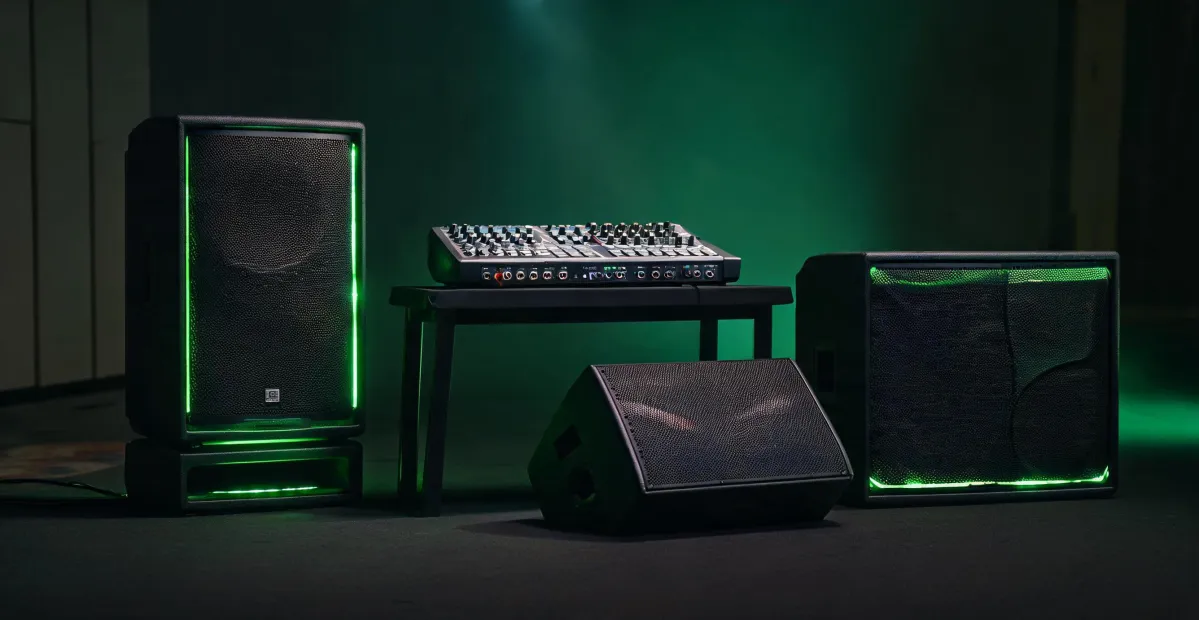
I run a small AV installation and rental company. I've been handling equipment orders for eight years. I've personally made—and documented—14 significant mistakes, totaling roughly $11,000 in wasted budget. Now I maintain our team's checklist, mostly so the new guys don't repeat my greatest hits.
Not a dime of that went toward a bad speaker.
If you've ever set up a solid powered speaker system—say, a pair of Mackie powered speakers with a subwoofer—and had it sound weak or muddy in the room, you know the specific panic I'm describing. The gear is right. The levels look right. The client is standing there with their arms crossed.
Here's what I learned the hard way: the problem is almost never the speakers. It's everything around them.
The Surface Problem: The Gear Looks Right, So Why Does It Sound Wrong?
Every setup is a promise. We promise the client that the pair of Mackie powered speakers and the subwoofer we spec'd will deliver a certain result. Then reality shows up.
The first instinct is to blame the hardware. I spent years doing that. I obsessed over which powered speaker model could push more output, swapped subwoofers, added EQ until the room sounded weird in a different way. Looking back, I was solving the wrong problem.
The specs on paper were fine. The rooms were fine. The signal chain was the problem. And the signal chain is the boring part nobody wants to spend money on.
What's Actually Happening: The Deep Causes
1. Spec Sheet Blindness
Marketing departments and their lawyers have a lot of room to move.
Why does this matter? Because two products can claim the same wattage and sound completely different. Per FTC guidelines (ftc.gov), advertising claims must be truthful and not misleading. But "truthful" leaves a lot of space for measurement tricks.
A 3000-watt peak rating might mean 300 watts RMS. A "cinema subwoofer" voiced for a treated room might be the wrong tool for an untreated restaurant corner. I learned this when I approved a subwoofer based entirely on its spec sheet, and it turned out to have a tuning completely wrong for the space. I assumed "same specifications" meant similar performance. Didn't verify. Turned out the manufacturer made decisions the spec sheet didn't reveal.
Numbers are a starting point. Not a conclusion.
2. Weak Links in the Signal Chain
Your Mackie powered speakers are only as good as what you feed them.
This is the most consistent theme in my mistake log. People build the system around the speakers, then connect everything with the cheapest cables and converters. Gain staging gets ignored because the meters on the mixer happen to look green.
The Mackie Onyx Producer 2.2 is a good example. People ask me about its price constantly—for good reason; street prices have been sitting around $130 in the quotes I've seen, which is honestly a steal for what it does. Verify current pricing, because it shifts with sales. But the interface doesn't fix bad levels. It's still just a box. If you feed it a clipped signal, the result is exactly what you deserve.
And it gets more confusing when video editing is involved. The Premiere Pro audio clip mixer looks deceptively like a fancy volume fader. It's not. It's a mixer. Set levels like one. If you're boosting clip volume by 6 dB, slapping a limiter on the master, and pushing the output into the red because it "sounds okay," you're creating a problem no microphone or interface can fix.
3. Subwoofer Placement Is Not Optional
The "subwoofer cinema" mistake cost me the most embarrassment. The word "cinema" sounds serious. A subwoofer in the corner of a small room sounds... boomy. Those two sentences should not connect the way they do in my memory.
I didn't understand boundary reinforcement for years. Put a sub in the corner and it gets louder—but also peakier and muddier. Move it away from the wall and the bass at your listening position can drop by several dB. Neither means the sub is broken. Both mean you're running a sub in a mode it wasn't designed for.
The worst part? A quick placement test with a tone generator and an SPL app would have shown me everything in about fifteen minutes, for free. Instead, I found out during a paying gig.
4. Buying Features Nobody Needs
Ever bought a feature because it felt professional?
I once purchased a Dante power amplifier for a two-zone install in a small store. The networking was impressive. The price premium was impressive. The client had zero Dante sources—not one—and no plan to add any. Why did I buy it? Because "Dante-ready" sounded like the future.
I remember the gut-versus-data moment clearly. Every spreadsheet said the Dante amp was overkill. My gut said it was future-proof. My gut was wrong. The data was right.
Here's what you need to know: small clients don't need future-proofing. They need something that works on Saturday and doesn't require a used-car budget. Buying features for a system that doesn't exist yet is not planning. It's spending.
The Price of Getting It Wrong
Let me attach dollar figures to this, because vague lessons don't stick. These are from my records.
January 2021: I ordered a "spec-comparable" budget pair of powered speakers instead of the Mackie pair I actually recommended. Saved $240. The client returned them after one event. Replacement cost, return shipping, and the lost repeat booking totaled around $700. The $240 savings looked brilliant for exactly eleven days.
September 2022: A $3,200 order for a small venue. Speakers, subwoofer, amplifiers—all checked, all tested at the shop. I walked into the venue two hours before the event and found the problem. Not the mixer. Not the speakers. A defective XLR cable that looked perfectly fine and cost $14. The client was patient. I wanted to evaporate.
June 2023: I had two amplifier options for a classroom install. The spec sheets were nearly identical, and the budget option was $130 cheaper. The numbers pointed one way. My gut said the build quality was flimsy. I went with the numbers. The amp worked—except for a cooling fan that sounded like a desktop PC from 2005. The teacher asked us to replace it within a week. The $130 savings became a $210 loss.
March 2024: I paid $380 to expedite a custom cable order for a corporate video shoot. I could have built the same cable with $14 of parts and thirty minutes in my own shop. I was rushing, and I paid for my own panic. The shoot got postponed anyway.
And the shipping. According to USPS (usps.com), a First-Class Mail letter costs $0.73 per ounce as of January 2025. Shipping a 35-lb powered subwoofer is not that. It's freight quotes and "two weeks, maybe." If you skip the insurance to save $12 on a $600 speaker, you're betting $600 to win $12. I took that bet once. I don't recommend it.
Total over eight years: roughly $11,000. That's a used car. That's a lot of quiet drives home after events.
The Solution: A One-Page Checklist and an Attitude Adjustment
After the third screwup in Q1 2024, I built a checklist. The whole team uses it now. We've caught 47 potential errors in the last 18 months—which sounds much better than "we've prevented 47 disasters."
- Draw the signal chain on paper before you leave the shop. Every cable. Every adapter. Every power connection. If you can't draw it, you don't understand it.
- Verify specs in the room, not just on the website. Bring a tone generator and an SPL app. Fifteen minutes of testing beats a week of returns.
- Set gain staging from source to speaker. Start quiet. Keep levels sane. In Premiere Pro, treat the audio clip mixer like a console—work the clips, don't push the master into the red.
- Buy the correct tool, not the impressive tool. No Dante amplifier unless the system actually has Dante sources. No new subwoofer until you've proven the placement is wrong.
And one more thing. When I was starting out, the vendors who treated my $200 orders seriously are the ones I still use for $20,000 orders. Small doesn't mean unimportant. It means potential. I try to be that vendor for the people who come to me with small budgets and big expectations.
The speakers are rarely the reason a setup sounds bad. The person who checks the cables, verifies the placement, and thinks before buying is the reason good setups sound good.
Be that person.

Elise Marceau
Elise Marceau is an LED display and digital-signage systems analyst covering LED video walls, modular screens, transparent LED, control processors, and indoor or outdoor signage. She applies IEC 62368-1 safety principles while comparing pixel pitch, luminance, contrast, refresh rate, colour uniformity, viewing angle, ingress protection, power density, module serviceability, and signal redundancy. Her specification guides help integrators, venue operators, retailers, and procurement teams align viewing distance, ambient light, content format, installation access, electrical load, and lifecycle support.