Mackie DLM8, Bluetooth Speakers, and a Powered Loudspeaker Checklist I Wish I'd Had Earlier
-
Who This Checklist Is For
-
The Checklist (With the Mistakes That Taught Me)
-
Step 1: Confirm the cabinet's real job, not just its name
-
Step 2: Test Bluetooth before you need it
-
Step 3: Build the system around the venue, not one cool feature
-
Step 4: Don't confuse a powered speaker with an amplifier
-
Step 5: Put lead times and backup plans in writing
-
Step 6: Walk the path from the truck to the stage
-
Step 1: Confirm the cabinet's real job, not just its name
-
One More Thing About 'Latest' Gear
-
The Bottom Line
I'm a live-sound tech who handles rental and install orders for a small production company. I've been doing this since 2019—six years of invoices, load-ins, amp racks, and one very annoying habit: writing down my mistakes. I've made 14 significant mistakes, totaling roughly $3,100 in wasted budget, and most of them happened while buying or deploying powered loudspeakers.
This checklist is the thing I wish someone had handed me before I recommended a Mackie DLM8 for a job that needed something completely different. It's not a review. It's a path.
Who This Checklist Is For
Use this if you're a sound engineer, rental company owner, AV installer, or lead volunteer responsible for 'getting the PA to work.' If you're an experienced systems engineer, some of this will sound obvious. That's fine. It was obvious to me too—after the invoice.
This is for situations where you need to choose, set up, or troubleshoot powered loudspeakers in a live or installed setting, especially with Mackie gear. I'll use examples from jobs I've actually run.
The Checklist (With the Mistakes That Taught Me)
I'll give you six steps. Step 6 is the one I'd never have included if I hadn't paid for it.
Step 1: Confirm the cabinet's real job, not just its name
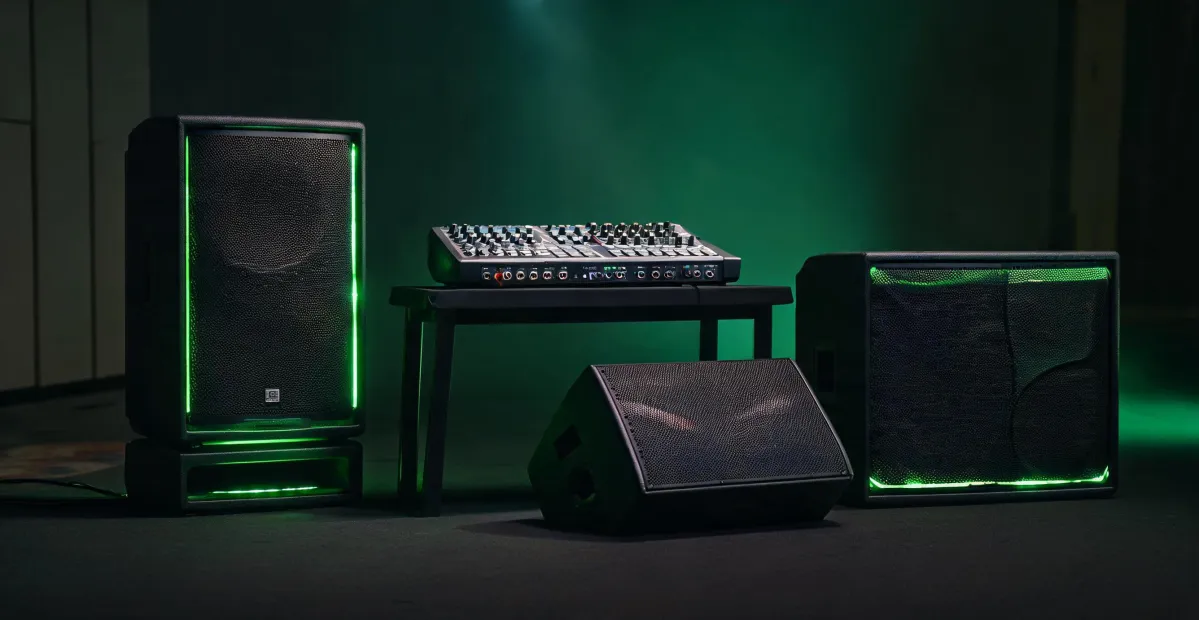
The Mackie DLM8 8" powered loudspeaker is a good example of a cabinet that's easy to love and even easier to misuse. It's compact, pretty loud for its size, and the full spec sheet is on Mackie's official page. But 'loud for its size' is not the same as 'loud enough for the room.'
I once used two DLM8s as main PA for a 200-person outdoor event. The room—er, the parking lot—needed low end and headroom. The DLM8s sounded fine until the band hit the downbeat, then it was mush. That was a $900 rental order, and I should have picked a pair of 12" cabinets with subwoofers.
What to check:
- Coverage pattern vs. the room shape
- SPL headroom relative to crowd size and music style
- Whether the speaker is meant to be a main PA, a wedge, or a delay fill
If you can't find a spec or you're guessing, pause. The spec sheet is your map.
Step 2: Test Bluetooth before you need it
Mackie speakers Bluetooth features are handy, especially on battery-powered units like the Thump Go. But 'handy' becomes 'unreliable' if you've never paired the unit before and you're trying to do it in front of a crowd.
I said 'we'll start from the playlist on my phone' at a wedding setup. The DJ heard 'we'll use the wired input.' We discovered the mismatch when the first dance began in silence. That's a communication failure, not a speaker failure. Now I test every Bluetooth source during load-in, including reconnecting after a forget/disconnect cycle.
Also check which codec the speaker supports. Some Mackie models use classic Bluetooth with limited distance. If the person with the playlist is more than 10 meters away, you might need a different plan.
Don't hold me to the exact Bluetooth version in every model—that's changed over the years. Look up the unit's manual before your gig.
Step 3: Build the system around the venue, not one cool feature
A powered loudspeaker is one part of a signal chain. You still need a mixer, cables, stands, and sometimes a sub. I'm not a fan of 'one-stop solution' thinking when it makes you ignore the missing pieces.
The 'audio mixer latest' features don't matter if the output of the mixer doesn't match the input of your speaker. I learned this in 2022 when I paired an old analog mixer with a digital speaker system and lost a channel because my cable ran through a bad DI box. The speaker was fine. The signal wasn't.
Before ordering, map the whole chain:
- Source → mixer → speaker input
- How many channels, what connectors, what cable lengths
- Whether the mixer has phantom power, DSP, or aux sends you actually need
If someone pitches you a 'full system' that magically does everything, ask which part isn't covered. A vendor who says 'that's not our strength—here's who does it better' is more useful than a generalist who overpromises.
Step 4: Don't confuse a powered speaker with an amplifier
This sounds basic, but I've had to undo it in three different orders. A powered loudspeaker has a built-in amp, but it's a full speaker system. A separate amplifier requires passive speakers, a crossover, and wiring. They're different tools.
For example, the Alpine KTA-450 Power Pack amplifier is a compact 4-channel car audio amp. I want to say it's rated around 45 watts RMS per channel, but don't quote me on that. It's for dash installs, motorcycles, and small 12V systems. It is not a PA speaker. I mention it because people see the word 'amplifier' and think 'I can connect this to a subwoofer and make a PA.' You can't, unless you're building a very specific installed system and you know what you're doing.
If a job calls for a powered PA speaker, choose a powered speaker. If it calls for a separate amp and passive speakers, choose the amp. Don't mix the two because one product happens to show up in your search results.
Step 5: Put lead times and backup plans in writing
I ordered four loudspeakers for a conference in September 2024. The vendor promised delivery by Thursday. It arrived the following Tuesday. The gig was Saturday. That mistake cost $890 in emergency rental gear and a one-week delay for the client's internal review. Actually, the delay was already baked into the schedule; the $890 was the rental replacement. Still painful.
Now I write every lead time into the purchase order. I also check stock status before ordering, and if a product is backordered, I ask for a named alternative model with a comparable spec. I don't accept 'should ship soon' from anyone.
Pricing and lead times change fast. I checked mackie.com in early April 2025 when I wrote this, but verify current availability before budgeting.
Step 6: Walk the path from the truck to the stage
This is the one most checklists miss. You can compare specs, verify Bluetooth, and choose the perfect DSP settings, but if the only way into the venue is a narrow staircase, your perfect speaker is still sitting in the parking lot.
On a gig in 2023, we brought a pair of compact powered speakers and a sub. The sub was doable. The route to the stage involved two flights of stairs and a 40-foot alley with no ramp. We rented a cart for $65, lost an hour, and I added 'path of travel' to my checklist.
Even the Mackie DLM8 is small, but its stand, cables, and cases add up. Think about weight, door widths, staircases, and how many trips your team can actually make.
This depends on your venue, obviously. If you're doing a single room with a loading dock, it's less of an issue. If you're doing mobile events, it's half the battle.
One More Thing About 'Latest' Gear
Every week there's a new product announcement in the loudspeaker news. I read those stories too. But the best gear for a job is the gear you can deploy safely, within budget, and with time to test. If you can't do those three, the spec sheet doesn't matter.
The 'more watts is always louder' thinking comes from an era before DSP limiting and active crossovers. That's changed. Modern powered speakers get their headroom from smart limiting, not just raw wattage.
I'm not here to tell you that Mackie speakers are the only option. I can only speak to my own experience. The DLM8 and Thump series have worked well for me when I chose them for the right reasons. When I chose them for the wrong reasons, it was my fault, not theirs.
The Bottom Line
Use this checklist on your next purchase:
- Confirm the cabinet's real job.
- Test Bluetooth before you need it.
- Build the system around the venue.
- Know whether you need a powered speaker or an amplifier.
- Get lead times in writing.
- Walk the path from truck to stage.
If you only remember one thing, make it this: a powered loudspeaker is part of a system. The best product is the one that fits the venue, the signal chain, and your team's ability to get it there. That lesson cost me about $3,100. Now it's free for you.

Elise Marceau
Elise Marceau is an LED display and digital-signage systems analyst covering LED video walls, modular screens, transparent LED, control processors, and indoor or outdoor signage. She applies IEC 62368-1 safety principles while comparing pixel pitch, luminance, contrast, refresh rate, colour uniformity, viewing angle, ingress protection, power density, module serviceability, and signal redundancy. Her specification guides help integrators, venue operators, retailers, and procurement teams align viewing distance, ambient light, content format, installation access, electrical load, and lifecycle support.