Why the Mackie Thump115S 1400W Powered Subwoofer Is My Rush-Order Pick
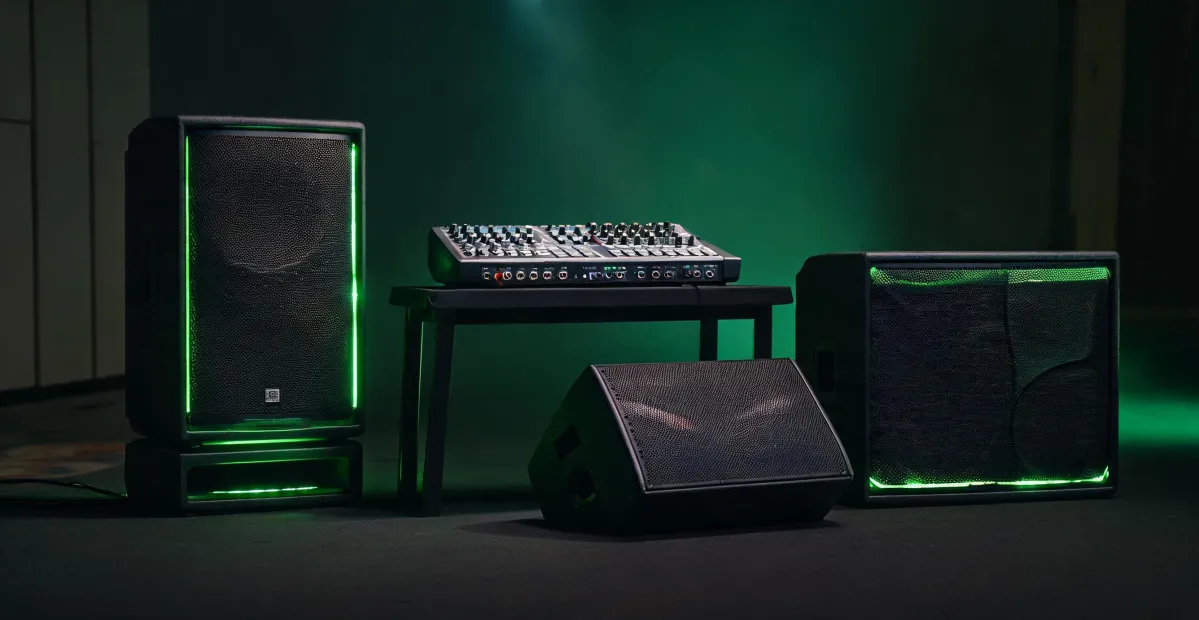
If you need a 15-inch Mackie subwoofer on site fast, the Mackie Thump115S 1400W powered subwoofer is what I send on short notice. It is not the loudest Mackie sub in our warehouse, and it is not the one I would spec for a festival stage. It is the one that removes the failure points—amp racks, external crossovers, questionable venue power, second trips—that actually sink rush gigs.
I coordinate audio equipment for a regional production company, so I am the person clients call when another vendor’s gear has just died. Since 2021, I have handled 200+ rush orders with a 95% on-time delivery rate. When the clock is short, the gear that wins is not the biggest box—it is the one that sets up fast, survives a bumpy van ride, and does not depend on a rack of external processing.
What the wattage number does not tell you
If you follow subwoofer news at all, you have seen the wattage race. Every new powered sub seems to ship with a bigger peak number than the last one. The 1400W figure on the Thump115S is real, but it is a peak rating, not a continuous rating. That distinction matters more than most event planners realize.
Per the FTC’s advertising guidance (ftc.gov/business-guidance/advertising-marketing), product claims must be truthful, not misleading, and substantiated. The practical translation: when a spec sheet says “1400W,” ask whether that is peak, program, or continuous. Peak numbers are marketing; continuous numbers are what your ears actually get.
I would argue the bigger story is the amplifier inside the cabinet. The Thump115S has its own amplifier, crossover, limiter, and protection circuitry built in. That means one less amp rack to build, one less cable snake to troubleshoot, and no venue tech secretly changing your crossover settings. For a rushed setup in a dark room, that is worth more than an extra three decibels.
The field test that changed my policy
In March 2024, a client called at 4 p.m. Their passive 18-inch sub had failed during load-in at a hotel. The event was a 300-person product launch at 8 a.m. the next morning. Normal turnaround for that client is two to three business days; we had five hours—which, honestly, felt luxurious compared with some of our calls.
The client’s tech wanted another 18-inch box because the original rider said “18-inch subwoofer.” But the room was a wide, low-ceiling ballroom, and the 18-inch box had been causing low-end mud at the back wall. We brought the Mackie Thump115S 1400W powered subwoofer, set the internal crossover to 100 Hz, and placed it near the stage. It gave the mains the low-end support the room needed without energizing every corner.
Show ran clean. The client bought the sub from us a week later.
What almost killed that order was not the speaker. I assumed the hotel ballroom’s power layout was the same as the last event we had done there. Didn’t verify. Turned out the only circuit near the stage was a 15-amp outlet shared with the service pantry. We had a 50-foot extension cord in the van, so we recovered. But after that, “verify venue power” became a permanent step in our dispatch checklist. It has caught real problems three times since.
What I actually check before promising a sub by tomorrow
If you are building your own version of this checklist, do not start with specifications. Start with logistics. Here is what gets people in trouble on a rushed sub order:
Power at the placement spot. A 1400W powered sub cannot help you if the stage circuit is already handling lighting. Confirm what is available, how far the outlet is from the sub’s position, and whether anything else shares the breaker. This is the most common miss—and the easiest to fix if you check before you load the van.
Physical access. We measure doors, stairs, and freight elevators before we send gear on urgent jobs. If the box does not fit through the loading door, the rest of the plan does not matter. This is one reason I like a 15-inch powered sub for rush work: one person can move it, and it fits through a standard 30-inch doorway with room to spare. So glad I started measuring after a dock lift failure last fall—we would have been stuck on the sidewalk with a double-18 rack.
What the event actually contains. A single 15-inch sub is ideal for playback, speech, and light band work. If the client says the words “DJ” or “heavy 808s,” send more sub or be honest about the limit. I still kick myself for sending one 15 to a corporate afterparty where the DJ’s kick drum ate us alive. If I had read the event order more carefully, two subs would have fixed the night.
A universal backup amplifier. Our emergency van now carries a backup power amplifier. The unit is a 400-watt Class-AD 2-channel amplifier which can drive most passive tops or wedges on site if a powered speaker’s internal amp dies. It is not glamorous, and it is not a Mackie product—but if I had owned it three years earlier, it would have saved me from two very expensive courier deliveries. Now it is non-negotiable.
The wrong-tool problem
Rush timelines make otherwise rational people reach for whatever is closest. I once had a client’s office manager ask if a Lenovo K3 loudspeaker from her office could cover an outdoor retirement party. It is a decent little consumer speaker—I am not knocking it—but it was never designed to project across an open lawn. We brought the Mackie rig, and the Lenovo K3 stayed on the reception desk.
That sounds obvious, yet the same logic applies to subwoofer decisions under pressure. Just because a box is big, or just because it is the first one you see in the warehouse, does not mean it is right for the room, the crowd, and the deadline. The best subwoofer for an emergency is the one that reduces risk while it plays loud enough.
Where I will not use the Thump115S
To be fair, this sub has limits. If you are covering an 800-capacity room with a live drummer, or an outdoor stage that is 50 feet wide, a single 15-inch powered sub will run out of headroom. The answer is more subs, bigger subs, or both—and that requires lead time, not a miracle.
I also will not push any sub into its limiter all day in direct sun and expect it to survive. Thermal protection is a real constraint. If the rig is outdoors for hours, shade the sub and keep the gain reasonable.
So here is my rule: The Mackie Thump115S 1400W powered subwoofer is the answer when the deadline is short, the room is moderate, and the client needs a reliable 15-inch Mackie sub that shows up, plugs in, and works. For anything bigger, start earlier. No wattage number will ever replace two days of lead time.

Elise Marceau
Elise Marceau is an LED display and digital-signage systems analyst covering LED video walls, modular screens, transparent LED, control processors, and indoor or outdoor signage. She applies IEC 62368-1 safety principles while comparing pixel pitch, luminance, contrast, refresh rate, colour uniformity, viewing angle, ingress protection, power density, module serviceability, and signal redundancy. Her specification guides help integrators, venue operators, retailers, and procurement teams align viewing distance, ambient light, content format, installation access, electrical load, and lifecycle support.