Mackie Thump 215 vs. Mackie 15-Inch Powered Speakers: What a Quality Inspector Would Buy
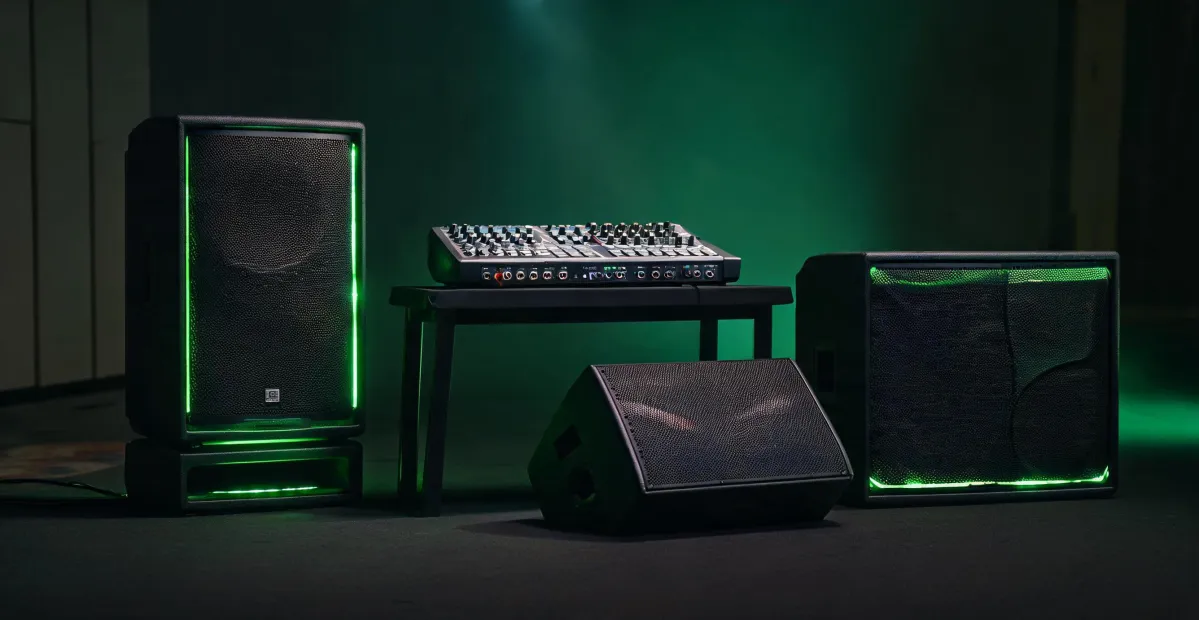
Mackie 15-Inch Powered Speakers: Two Ways to Build a PA
I've spent the past four years as a quality and compliance manager at a professional audio company. I review roughly 300 units a year before they reach customers, and I've rejected my fair share of first samples. In our 2024 audit, 8% of initial builds came back with mounting hardware or solder issues. So when I talk about gear, I'm not reciting marketing bullet points. I'm thinking about what breaks and what doesn't.
This article compares two ways to set up a small PA. One option is the Mackie Thump 215 speaker on its own. The other is a modular system built around Mackie 15 inch powered speakers with a real subwoofer and, if you need to manage inputs, a physical audio mixer for Windows. I'll make the comparison in the dimensions that matter most to live sound and rental work.
The Sony SA-SW3 Subwoofer Is Not a PA Sub
Here's the part that surprises people. The Sony SA-SW3 subwoofer is a fine home theater product. If you have a Sony soundbar and want to feel explosions, it does that job. But I've seen this sub show up in rental quotes as 'the sub,' and it doesn't belong there.
A PA subwoofer needs balanced line inputs, high output, and a cabinet built for stage abuse. The Sony SA-SW3 is designed to connect to a soundbar wirelessly. There's no XLR input, no line-level input for your mixer, and no protection circuitry for continuous live program material. It's not a bad product; it's the wrong category. Leave it with your TV.
Do You Need a Good Power Amplifier?
A lot of searches for 'good power amplifier' come from people who think every PA needs an external amp. Sometimes that's true—if your speakers are passive. If you're using the Mackie Thump 215, the amplifier is already inside the speaker. According to Mackie's product page (mackie.com, accessed February 2025), the Thump 215 is a powered 15-inch PA speaker with internal amplification. You don't need an external power amp for it.
In a modular system with Mackie 15 inch powered speakers, the same logic applies. The money you'd spend on an external amplifier is better used for a subwoofer or a physical mixer. If you own passive 15-inch cabinets, then a good power amplifier is a different story—but that's not what this comparison is about.
A Physical Audio Mixer for Windows Still Makes Sense
This is where I have a definite opinion. A physical audio mixer for Windows is not an old-fashioned choice. It's often the more reliable one.
I've tested enough interfaces and USB mixers to appreciate a hardware desk. You get analog preamps, dedicated EQ knobs, and latency-free monitoring without opening a software panel. On Windows, driver issues are the classic failure point. That's why I prefer a class-compliant mixer: plug it in, and Windows treats it as a standard audio device. No custom driver, no 'why isn't my sound working' moment before a show.
Can you mix inside a DAW? Yes. But if the laptop glitches, a hardware mixer still feeds your powered speakers. In live sound, that separation is a feature.
Bass, SPL, and the Thump 215
Let me be fair to the Mackie Thump 215 speaker. For a 15-inch powered PA speaker in its price range, it's plenty loud for vocal and acoustic work. But a full-range 15-inch top can only do so much when you push kick drum and bass through the same woofer. The low end and midrange compete for the same cone.
That's why a dedicated PA subwoofer changes the system. When the sub handles frequencies below 80-100 Hz, the 15-inch top can focus on vocals and instruments. The result is clean and less fatiguing. This is the dimension where the Thump 215 alone loses to a modular setup—but only if the sub is a real PA sub, not a home theater Sony SA-SW3 subwoofer.
So Which System Do I Recommend?
Short answer: it depends on the gig. That's not a dodge; it's a spec decision. In live sound, the more honest answer is usually the better one. A system that's right for a 100-person bar is not the right system for a 300-person outdoor wedding, and that's okay.
Choose the Mackie Thump 215 speaker alone if:
- You do solo acoustic, speech, or small corporate events.
- You need a system that fits in a car.
- Your audience is under 150 people and there's no DJ set.
Choose a modular system with Mackie 15 inch powered speakers and a real PA subwoofer if:
- You're running a full band or a DJ.
- You need low end for kick, bass guitar, or electronic music.
- You're setting up for 200+ people or outdoor events.
One More Thing: The Spec That Gets Ignored
If you already own a Sony SA-SW3 subwoofer, keep it in your living room. Looking back, I should have told a client that more directly during the quote phase instead of after the sound check. We spent an hour trying to EQ around a system that was never going to deliver what the gig needed.
Pricing and specs change. This was accurate as of February 2025. The Mackie Thump 215's street price varies by dealer and promotion, and a bundled subwoofer/mixer deal can change your decision. Verify current prices, read the spec sheets, and buy the best match for the actual gig.
Bottom line: the Mackie Thump 215 is a dependable speaker. Mackie 15 inch powered speakers are solid workhorses. But don't expect one box to do everything. If you need real low end, buy a real PA sub—and leave the Sony SA-SW3 at home with the soundbar. If you're tying a PA into Windows, a physical audio mixer for Windows is still the most reliable path I know. Trust me on this one.

Elise Marceau
Elise Marceau is an LED display and digital-signage systems analyst covering LED video walls, modular screens, transparent LED, control processors, and indoor or outdoor signage. She applies IEC 62368-1 safety principles while comparing pixel pitch, luminance, contrast, refresh rate, colour uniformity, viewing angle, ingress protection, power density, module serviceability, and signal redundancy. Her specification guides help integrators, venue operators, retailers, and procurement teams align viewing distance, ambient light, content format, installation access, electrical load, and lifecycle support.