Mackie Mixers, Thump PA Speakers, and the Wrong Search Terms
-
Start Here: Three Scenarios (and a Couple of Search Terms That Don't Belong)
-
Scenario 1: DJ / Mobile PA — Mackie Thump215XT 15" Enhanced DJ PA Speakers
-
Scenario 2: When a Mackie Mixer for Sale Is the Right Purchase (and When It Isn't)
-
Scenario 3: Qorvo Power Amplifier and 2025 F-150 Subwoofer — Wrong-Store Searches
-
How to Tell Which Scenario You're In
I'm the guy who orders speakers and mixers for a small rental/install company. I've been doing this since 2017, and I've made enough mistakes to fill a short textbook. The $1,100 mixer mistake in 2022. The 15" speaker order that didn't fit through the venue door (which, honestly, should have been measured). The time I skipped the final spec check because "it's basically the same as last time." It wasn't.
So now, before every purchase, I run our team's checklist. The first thing I tell people: there is no single "best" Mackie product. The right answer depends on your scenario.
Start Here: Three Scenarios (and a Couple of Search Terms That Don't Belong)
If you're searching for Mackie gear, you probably fall into one of these scenarios:
- Scenario 1: You're a DJ or mobile performer looking at the Mackie Thump215XT 15" Enhanced DJ PA Speakers.
- Scenario 2: You're a venue, studio, or church buyer searching for a Mackie mixer for sale with XLR outputs.
- Scenario 3: You're actually hunting for a Qorvo power amplifier or a 2025 F-150 subwoofer — and you've landed in the wrong aisle.
I'll walk through each one. Then I'll give you the checklist I now use so you don't repeat my mistakes.
Scenario 1: DJ / Mobile PA — Mackie Thump215XT 15" Enhanced DJ PA Speakers
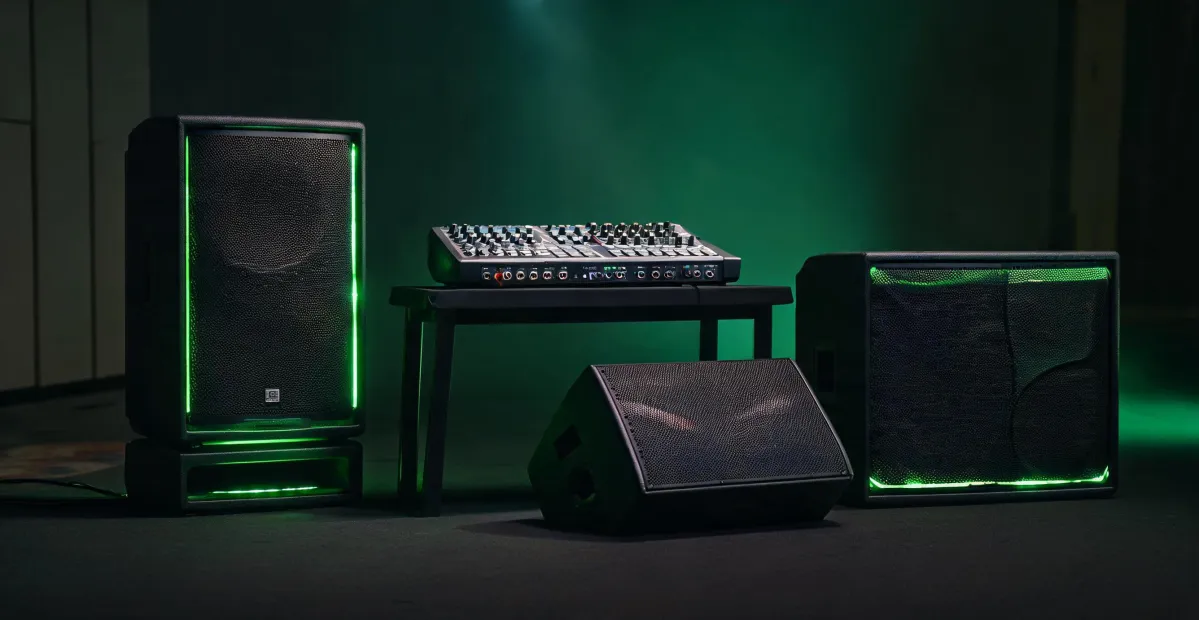
If you need to carry sound in and out of venues, powered speakers are your friend. The Mackie Thump215XT 15" Enhanced DJ PA Speakers are a solid match for mobile DJ work, solo performers, and small-venue hire. They are powered, so you don't need to chase down a separate amplifier. They also have built-in EQ shaping, a 15" woofer, and a compression driver. In my experience, they get loud enough for small-to-medium rooms, and for the money, they're hard to beat.
Here's the advice that goes against the usual "bigger is better" instinct: don't automatically buy the 15" just because it's the biggest. The 12" version is likely easier to carry and can still handle weddings, school dances, and bar gigs. The 15" makes more sense when you want low-frequency output without bringing a separate subwoofer. "Enhanced" in the product name tells you it's the newer version with updated presets and protection circuitry — it doesn't mean the older Thump speakers are suddenly bad.
One mistake I made in my first year: I ordered a whole system with all 15" tops and no subwoofers, because I thought "more cone = more bass." It was loud, but the low end in a room with 100 people felt boxy. The fix wasn't to buy even bigger speakers; it was to add a sub and use the 15" tops for kick and mid-bass. If you're doing a mobile DJ setup and your back already hurts from moving cable trunks, think about weight and room size before cone size.
Scenario 2: When a Mackie Mixer for Sale Is the Right Purchase (and When It Isn't)
Searching "Mackie mixer for sale" usually means you need to combine several audio sources and send them somewhere. The phrase that matters here is audio mixer with XLR output — but XLR can mean inputs and outputs, and those are very different things.
This is where I wasted $1,100 in 2022. I ordered six compact mixers because I saw XLR jacks in the photos. I assumed "XLR output" meant the main outputs were balanced XLR. They weren't. The XLR jacks were for microphones. The main outputs were 1/4" unbalanced. For our rack wiring, that was useless. Returned the whole order, lost three days, and learned to read the output section of the spec sheet.
Before you buy a Mackie mixer for sale, look for the phrase "balanced XLR outputs" in the spec sheet. In Mackie's lineup, the ProFX series (models like ProFX6v3, ProFX10v3, and ProFX12v3) is where I check first when someone needs a real XLR output for a PA or recorder. The compact mixers are handy, but not all of them have XLR main outs. Check, don't assume.
What about the opposite direction? If you only need one input and one XLR output for a podcast or a single microphone going into a computer, a full mixer might be overkill. A simple audio interface could do the job for less money and less desk space. I recommend Mackie mixers for bands, small venues, churches, and rental companies. I don't recommend one for a simple one-mic-to-laptop setup. That's not a quality issue; it's a matching issue.
Scenario 3: Qorvo Power Amplifier and 2025 F-150 Subwoofer — Wrong-Store Searches
Two search terms can land people on a Mackie page for the wrong reason. I'll be direct about both.
Qorvo power amplifier — Qorvo makes RF power amplifiers, not audio amplifiers for PA speakers. Their products go into cell phones, Wi-Fi modules, radar, and base stations. If you searched "Qorvo power amplifier" and ended up here, you should be looking at RF components, not Mackie loudspeakers. The word "power amplifier" means one thing in RF design and another thing in live sound. This is a category mix-up, not a brand comparison.
2025 F-150 subwoofer — If you're building a subwoofer system for a Ford F-150, you need a car audio subwoofer in an enclosure designed for the truck. Mackie Thump subwoofers are powered PA subs built for live-sound use on a stage or floor. Some 2025 F-150 trims have Pro Power Onboard 120V outlets, but that still doesn't make a PA sub a sensible truck install. You'd be giving up cargo space, adding a heavy box that isn't secured to vehicle specs, and the bass response would be built for open air, not a sealed cabin.
This is the part where I say Mackie isn't right for everything. The Thump215XT is for live sound. The ProFX mixers are for audio mixing. PA subwoofers are for stages, not truck beds.
How to Tell Which Scenario You're In
Before you search "Mackie mixer for sale" or type in a product model, ask yourself four questions:
- What problem am I solving? If you need to make a band louder, look at powered speakers. If you need to route multiple mics into one output, look at mixers.
- What power source is available? Mackie Thump speakers and PA subs need 120V AC. If you're planning a 2025 F-150 subwoofer, you're probably looking for a car audio setup, not a PA sub.
- What outputs does the device I'm connecting to accept? If it needs XLR, choose a mixer with balanced XLR main outputs. Verify on the spec sheet.
- Is the amplifier I'm searching for audio or RF? If the search includes "Qorvo," it's RF. If it includes "DJ PA speakers," it's audio.
Spec details and product names can change, and they were pulled from Mackie's official product pages as of April 2025. Confirm current pricing and connectors before you order — that step alone has saved me from more than one expensive mistake.
The best Mackie setup isn't the one with the most watts or the biggest sub. It's the one that matches your transport, your power source, and your outputs. I learned that by wasting money. Now I use a checklist, and it's probably saved me close to $10,000 in wrong orders over the last two years. I'd rather you skip that tuition.

Elise Marceau
Elise Marceau is an LED display and digital-signage systems analyst covering LED video walls, modular screens, transparent LED, control processors, and indoor or outdoor signage. She applies IEC 62368-1 safety principles while comparing pixel pitch, luminance, contrast, refresh rate, colour uniformity, viewing angle, ingress protection, power density, module serviceability, and signal redundancy. Her specification guides help integrators, venue operators, retailers, and procurement teams align viewing distance, ambient light, content format, installation access, electrical load, and lifecycle support.