Powered vs Component PA Systems: What $4,800 in Bad Purchases Taught Me
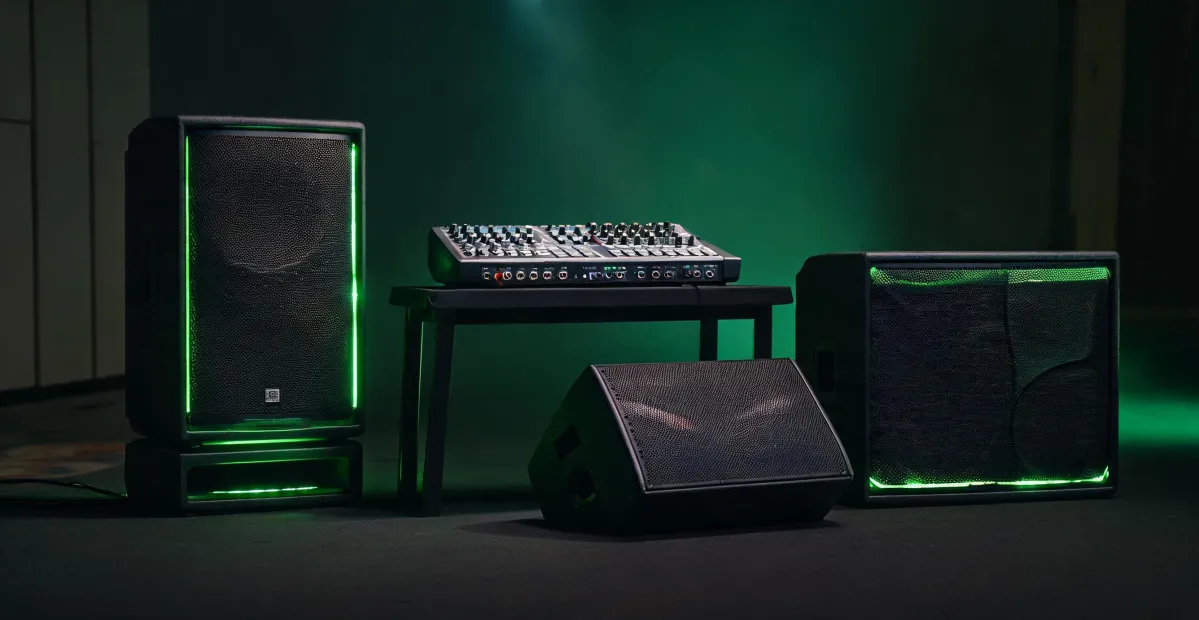
I run a small event audio rental operation. Six years in, I've set up PA systems for weddings, corporate gigs, and weekend bar shows—and I've spent about $4,800 on purchases I regret. Not theoretical. Actual money wasted. Now I keep a checklist taped inside our storage room door so nobody on my team repeats my mistakes.
Here's the comparison I wish someone had handed me back in 2019: all-in-one powered PA systems (like the Mackie SRM or Thump series) versus component systems — separate power amplifiers, passive speakers, and an external mixer.
If you're equipping a rental fleet, a church, or a small touring rig, this decision determines your setup time, your repair costs, and what happens when something fails at 30 minutes before showtime. I'm going to break it down across five dimensions I've learned to care about the hard way.
Dimension 1: Setup Speed and Deployment
This is where the gap is widest, and it's the reason I switched most of our rental stock to powered boxes.
Powered systems: Grab the speaker, run a power cable and an XLR from your mixer, done. A pair of Mackie powered speakers 15-inch models can be fully deployed by one person in under ten minutes. I've done it in parking lots, on rooftops, in basements with exactly one working outlet.
Component systems: Now you're running speaker cable from an amp rack to each passive box, managing amplifier gain settings, and praying nobody trips over the speakON connector. In my first year (2017), I showed up to a corporate event with a component rig and spent 45 minutes just troubleshooting a ground loop hum. The client was standing behind me the whole time.
The verdict: For anything mobile or time-sensitive, powered wins decisively. The only scenario where component systems make sense for setup is a permanent install where the rack stays put and gets tuned once.
Dimension 2: Scalability and System Matching
This is the one dimension where component systems actually have a real argument. I'll give them that.
Powered systems: Each box has a fixed amplifier matched to its driver at the factory. That's great for reliability—the Mackie SRM1801 powered subwoofer, for example, comes with its amp and DSP already tuned. You plug it in and it sounds like it should. But if you need more output, you buy more boxes. You can't just swap in a bigger amp.
Component systems: You can upgrade the amplifier without replacing speakers, or vice versa. I once watched a colleague swap a single rack amp to double his headroom for an outdoor gig. Took him twenty minutes. With powered boxes, he would have needed to rent two additional units.
But here's the catch—and this is what cost me $1,100 in 2020. Matching amps to passive speakers requires understanding impedance, power ratings, and crest factor. I got it wrong. I paired a budget amp with speakers that dipped to 2 ohms under load, and the amp shut down mid-set at a wedding reception. The bride's father was not amused.
"If you don't already know how to read an impedance curve, component systems will punish you for it."
Dimension 3: Low-Frequency Performance and Subwoofer Integration
Bass is where rental clients judge you. If the kick drum doesn't hit, they remember it.
Powered systems: Adding a sub is straightforward. You run a crossover output from your top boxes or use the sub's built-in crossover. The Mackie SRM1801 powered subwoofer is a good example—it has its own amplification and handles the crossover internally. One cable, done.
Component systems: Now you need a separate amplifier channel for the sub, an external crossover (unless your amp has one built in), and the knowledge to set crossover points correctly. I've seen too many component rigs where the sub is running full-range because nobody set the low-pass filter. That's not bass. That's mud.
From experience: powered subs are easier to get right. Component subs give you more headroom per dollar if you know what you're doing—but if you don't, you'll spend that savings on aspirin.
Dimension 4: Mixing and Signal Chain Complexity
Here's something people don't talk about enough: your mixer choice is tied to your speaker choice more than you think.
Powered systems: Many powered boxes accept mic and line inputs directly, which means for small gigs you can skip the mixer entirely. But for anything with more than two sources, you'll want a proper board. Something like a G3 audio mixer (or equivalent compact digital mixer) pairs well because it gives you enough channels without adding a rack space. The signal chain stays short: source → mixer → powered speaker. Fewer connections, fewer failure points.
Component systems: You're adding at least one more device—the power amplifier—into the chain. More cables, more gain stages to set, more places for hum and ground loops to creep in. I've spent entire afternoons chasing noise in component rigs. It's always a ground loop. Always.
On a related note: if you're considering a high-end amplifier like a Musical Fidelity M8s-500s for a fixed installation, understand that it's designed for a different use case than live sound reinforcement. It's a phenomenal piece of equipment—but it's not going to replace a proper PA amp for a rental fleet. Different tools, different jobs.
Dimension 5: Total Cost of Ownership
This is where the value-over-price argument matters most. I've learned this lesson three separate times.
On paper, component systems look cheaper. Passive speakers cost less than powered ones, and a single amplifier can drive multiple boxes. But the hidden costs pile up:
- Speaker cable: Good gauge cable isn't free. For long runs, it adds up fast.
- Rack and case: Amps need protection. That's another $200–$400 depending on size.
- Setup labor: If you're paying a tech, component systems take 2–3× longer to deploy. At $25/hour, that's real money over a season.
- Failure diagnosis: When something goes wrong in a component rig, you have to isolate the problem across five or six devices. With powered speakers, it's usually the box or the cable. Two possibilities.
Looking back, I should have paid more attention to total cost rather than sticker price. My first component system saved me about $600 upfront. It cost me roughly $2,300 in labor, replacement parts, and one very awkward conversation with a client whose event had no sound for twenty minutes.
There's also a portability angle worth mentioning: battery-powered options like the Mackie Thump Go have changed what's possible for outdoor ceremonies and remote locations. No power outlet? No problem. That's a capability component systems simply cannot match without a generator.
So Which One Should You Buy?
It depends on your scenario. Here's how I'd break it down now:
Go with powered systems if: You're renting out gear, you do mobile gigs, your team includes non-technical staff, or you need to set up and tear down quickly. The Mackie powered speaker ecosystem—tops, subs, and battery-powered options—covers most small-to-mid venue needs without requiring an engineering degree. Also, an amplifier like a Drone power amplifier might look tempting for a budget build, but do your homework on reliability before committing to a fleet purchase. I've been burned by "good enough" amps before.
Go with component systems if: You have a permanent installation, you (or someone on your team) genuinely understands amplifier matching, and you want the flexibility to upgrade individual components over time. Churches and clubs with a fixed setup and a knowledgeable volunteer or staff member often do well with this approach.
What I'd avoid: Mixing and matching cheap component gear without understanding the specs. That's what cost me the most money. If you don't know why a 4-ohm load matters, start with powered boxes and learn on those.
I have mixed feelings about my early component purchases. On one hand, I learned a lot by making mistakes. On the other, I could have learned the same lessons by reading a manual and asking one experienced person. $4,800 is an expensive education.
If you're just starting out, do what I should have done: buy a pair of quality powered speakers, add a sub when you need it, and put your money into a decent compact mixer. You can always build a component rig later—once you actually know what you're doing. That's the checklist item I wish I'd had from day one.

Elise Marceau
Elise Marceau is an LED display and digital-signage systems analyst covering LED video walls, modular screens, transparent LED, control processors, and indoor or outdoor signage. She applies IEC 62368-1 safety principles while comparing pixel pitch, luminance, contrast, refresh rate, colour uniformity, viewing angle, ingress protection, power density, module serviceability, and signal redundancy. Her specification guides help integrators, venue operators, retailers, and procurement teams align viewing distance, ambient light, content format, installation access, electrical load, and lifecycle support.