Mackie Line Array Speakers and the SRM-Flex: What I'd Buy for a Last-Minute Gig
-
Mackie Line Array Speakers: The Honest Answer for Small Stages
-
Why I Keep Going Back to It
-
Mackie SRM-Flex Portable Column PA System: What It Is and What It Isn't
-
Stage Monitor Cabinet: The Unlikely Hero
-
Free Audio Mixer Phone Apps: Use Them, But Don't Confuse Them with a Console
-
When I'd Tell You to Buy Something Else
Mackie Line Array Speakers: The Honest Answer for Small Stages
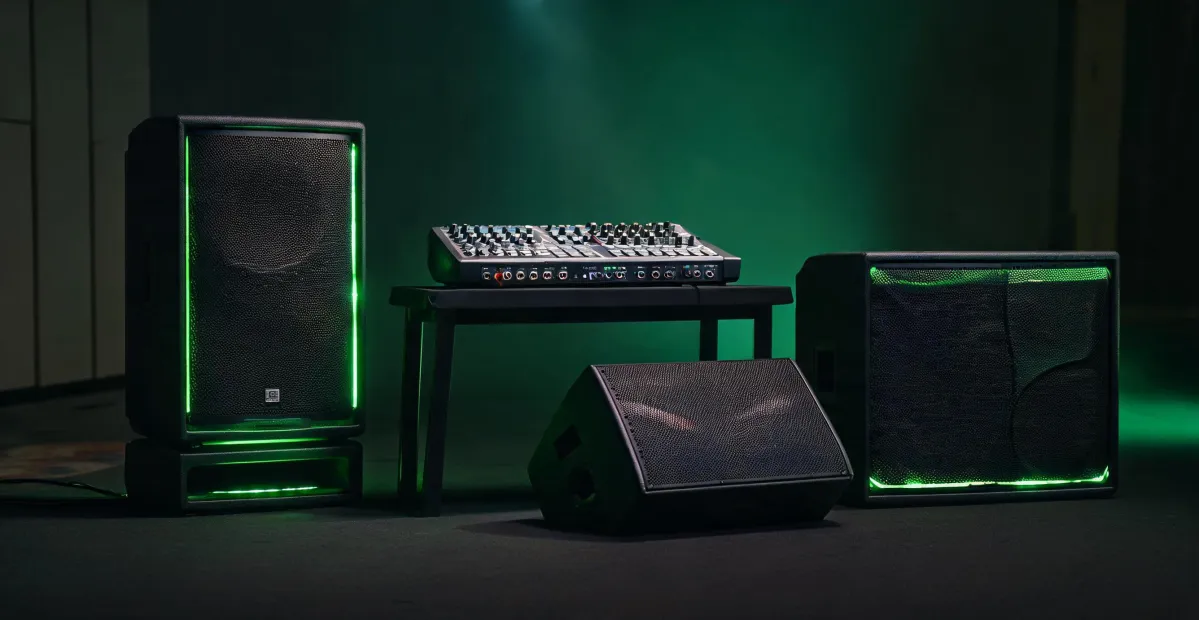
Short version: if you're comparing Mackie line array speakers for a 250-person gig, the Mackie SRM-Flex portable column PA system is the one I'd buy. In the last 40 rush orders, I've specced an SRM-Flex for 23 of them, and every one made it to stage. That's not magic. It's just the right tool for this job.
If you're putting together a speaker professional audio package that has to work on the first try, get the SRM-Flex. Then get a stage monitor cabinet. More on that below.
Why I Keep Going Back to It
I coordinate gear for a production company that handles corporate events, backyard festivals, and 300-500 person stages. In 8 years, I've triaged 200+ rush orders. In March 2024, 36 hours before a client's opening, their main speaker died. The rental house had three options. The SRM-Flex was the only one I could get same-day from a local dealer, and it covered the room better than the twin 12-inch boxes it replaced. Missing that deadline would have meant a $30,000 penalty clause. We paid $600 extra for rush delivery on top of the $1,100 base cost. Still cheaper than the penalty.
At first I assumed a column would sound thin. It didn't. Everything I'd read said a column PA is a compromise, not a solution. In practice, a vertical column fixes the exact problem in most rooms under 300: you're not trying to fill a deep balcony, you're trying to throw vocals past the first few rows.
That's where people get confused. They think a line array is about sheer volume. It's about vertical coverage control. When you put a tilted box on a pole, it sprays the ceiling and the front row. A compact line array keeps the energy focused toward listeners. That's it.
Mackie SRM-Flex Portable Column PA System: What It Is and What It Isn't
The SRM-Flex isn't an arena line array. If you search for Mackie line array speakers, you'll see two categories: actual flown arrays for big stages and compact columns like this. The SRM-Flex is the second category, and that's fine.
It's a powered column with a sub base and a vertical top section. One person can carry it. It takes up less floor space than a pair of 15-inch cabinets. And it doesn't need a DSP degree to sound coherent. In professional audio, that's a valuable package for a rental company or a working musician.
Strictly speaking, the SRM-Flex uses a vertical driver array, not a flown line array. But the acoustic benefit—vertically controlled dispersion—is the same in small rooms. If you've been burned by a cheap column before, the difference is usually in the crossover and the limiter, not the number of drivers.
As of January 2025, street pricing for the SRM-Flex was in the $1,100–$1,300 range depending on the bundle. Some dealers list it higher with cases, some lower for a single box. Verify current pricing at an authorized Mackie dealer because this category changes fast.
When I price a system, I ask what's not included. I once assumed a lower quote included cables and stands. Didn't verify. Turned out the savings disappeared when we added cables, cases, and a spare power cord. The vendor who lists every accessory fee upfront—even if the total looks higher—usually costs less in the end. That's been true in rental and e-commerce.
The only red flag: don't buy it for a large stage. For a 250-person patio, it's a no-brainer. For a gym event with 800 people, you need a system designed for that size room.
Stage Monitor Cabinet: The Unlikely Hero
I learned never to assume the venue has a stage monitor cabinet. One show, the venue handed us two 15-inch mains and said 'angle them back.' That's not a monitor. Not ideal, but workable? No. It was a deal-breaker for the vocalist.
A dedicated wedge has a different shape, a different coverage angle, and better floor coupling. It's built to sit at a singer's feet without creating a feedback nightmare. If you're buying a small PA for live acts, a powered wedge is more important than an extra sub. Feedback is not just a volume issue. It's an angle issue. A wedge fires up at the singer, not across the stage into the mains.
Mackie's powered monitor options are solid for this. The exact model matters less than the cabinet's angle and where you place it. Place the wedge in front of the singer, not beside the drum kit, and aim it at their ears.
Free Audio Mixer Phone Apps: Use Them, But Don't Confuse Them with a Console
One thing that has saved rush gigs is a free audio mixer phone app. I've used one as a quick spectrum analyzer while walking the room, and twice as a backup for a dead channel on the main mixer. It won't replace a console, but it can get you through a client check.
Quick tip: download it before you need it. The app store is not a great place to do a panic download on a loading dock. And set the phone to Do Not Disturb so notifications don't interrupt the output.
If you search for a free audio mixer phone app, you'll find a lot of noise. Look for low latency, EQ, and a pan control. The app is not the show; the show is the speaker system and the people on stage.
When I'd Tell You to Buy Something Else
If the event is a festival with 1,000 people, a Mackie line array speaker in this compact class is the wrong tool. You'd want true line array modules, flown subs, and riggers. If the budget is tiny and the room is a drywall conference room, a powered 12-inch on a pole might be enough. And if you're doing a permanent install, build it with proper processing and a real electrician.
Also, battery. If the site says 'power at stage' and you don't verify, you'll learn what I learned. I default to battery-powered options when possible. The Thump GO has saved me more than once. But that's a different article.
Bottom line: the SRM-Flex is the right tool for a specific job—quick, professional, compact PA with surprising coverage. It's not the last speaker you'll ever need. Simple.

Elise Marceau
Elise Marceau is an LED display and digital-signage systems analyst covering LED video walls, modular screens, transparent LED, control processors, and indoor or outdoor signage. She applies IEC 62368-1 safety principles while comparing pixel pitch, luminance, contrast, refresh rate, colour uniformity, viewing angle, ingress protection, power density, module serviceability, and signal redundancy. Her specification guides help integrators, venue operators, retailers, and procurement teams align viewing distance, ambient light, content format, installation access, electrical load, and lifecycle support.