I Fried $4,200 in PA Gear Before I Understood What 'Loudspeaker Paradigm' Actually Means
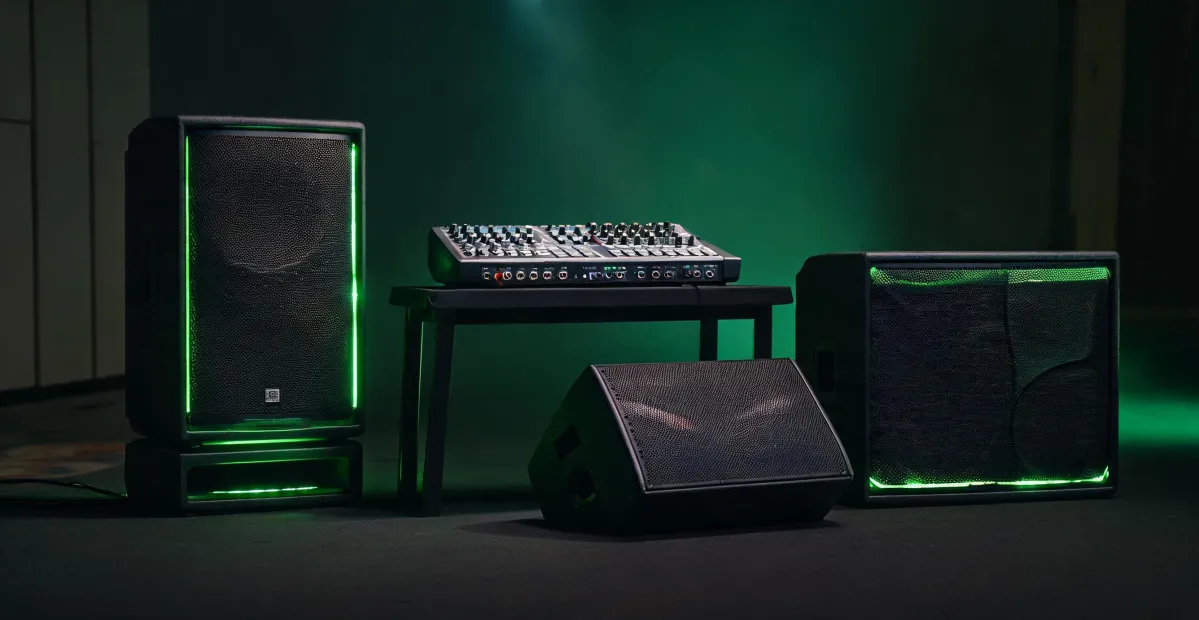
I'm not an acoustics engineer — I run rental orders for a small AV outfit, about 140 jobs a year. I've personally blown up roughly $4,200 worth of gear across three years, and every single failure traced back to a decision I made before the speakers ever got plugged in. So if you're staring at a "pa speaker sale nearby" listing and thinking the price is the whole story, let me save you some tuition.
The Problem You Think You Have
A customer asks for a small outdoor setup. Corporate patio event, maybe 60 people, background music plus a couple of mics. You grab a pair of cheap 8-inch passive boxes off a local sale, wire them to whatever amp is sitting in the rack, and call it done.
Then halfway through the second set, the high-frequency driver on the left box goes quiet with a faint pop. Then the amp channel dies. You swap cables, swap speakers, and by the time you've diagnosed anything the client is listening to a phone through a Bluetooth puck. That's the version of the problem you think you have: bad speakers.
The version I actually had, three times, was different.
The Real Problem: You're Matching Boxes, Not Systems
Here's what most people don't realize: a loudspeaker isn't a standalone product that either "works" or "doesn't." It's one component in a chain that includes amplifier headroom, AC power quality, crossover behavior, and — critically — how hard the amp is being pushed relative to what the drivers can dissipate.
When I killed that first pair of drivers, I was feeding a pair of nominal 8-ohm boxes with an amp rated at 250W per channel into 4 ohms. On paper that looks fine. In practice, running that amp near its ceiling on a hot September afternoon meant it was clipping for maybe 15% of the peak transients — and clipped square waves cook HF drivers faster than almost anything else. The speaker didn't fail. I drove it into a failure.
Saved maybe $180 buying the cheaper amp channel config. Ended up spending just over $600 on replacement drivers and a bench repair — plus the client credit I had to hand out to keep the contract.
The power filter I ignored for too long
Second failure, different venue, same story. Warehouse event, generator-fed AC, voltage sagging whenever the catering equipment cycled on. I had a power strip. I did not have an amplifier power filter or any real conditioning. The amp's own protection circuit tripped twice mid-show and I didn't think much of it.
What I didn't understand yet: repeated brownouts on a class-D amp are not a neutral event. The supply rails collapse, the amp tries to recover, and you get transient spikes on the output stage that go straight into the voice coils. Took out one of the woofers and a driver on the other box. That one cost me closer to $900 in parts and a lost repeat booking.
I don't have hard data on how often brownout-induced amp damage actually occurs across the industry — I wish I'd logged my own incidents more carefully instead of just eating them. What I can say anecdotally is that every gear failure I've had in rental service since 2022 has had a power-side component, even when the speaker was the thing that visibly died.
What the Failures Actually Cost
Let me be concrete, because "it was expensive" doesn't teach anyone anything.
- Failure 1 (September 2022): two HF drivers, one amp channel repair. $612 in parts, $150 bench fee, one client credited $300.
- Failure 2 (June 2023): one 15" woofer recone, one HF driver, plus a rushed replacement amp rental. $890 total, plus a booking that didn't renew.
- Failure 3 (January 2024): this one was on me for shipping a mismatched setup to an offsite. Two 8-inch boxes pushed past their rated SPL on a corporate gig, both drivers toast. Roughly $740 in replacement gear and a very awkward Monday phone call.
Add in the unbilled hours — the diagnosis time, the last-minute swaps, the driving to pick up loaner units — and I'm comfortably at the $4,200 figure. On a business that runs maybe $60K a year in gear-related spend, that's not a rounding error. That's a month of margin.
The credibility hit is harder to price. Two of those clients didn't book again. You can't put a line item on that, but you feel it.
The Fix, Which Is Dumber Than I Want to Admit
I'm not going to walk you through the whole workflow — that's a different article and honestly a different skill set. What I'll tell you is the three changes that stopped the bleeding, in the order they actually mattered.
1. Stop matching mismatched gear. Buy systems.
This is where I finally started paying attention to how a powered speaker expects to be fed. When you run a Mackie 8 inch powered speaker — or any self-powered box in that class — the amp, crossover, and driver protection are already matched at the factory. You can't accidentally underpower it. You can't accidentally clip the input stage into the driver. The matching problem is solved for you.
For small-format setups, the combo I keep on the shelf now is a Mackie CR3.5BT + CR8SBT subwoofer combo. Small monitors up top, matched sub handling the low end, all self-powered, all internally crossed. It's not a line array and it's not trying to be. It's a system that does one job — desktop and small-room playback with a sub — and does it without asking me to do math on a Tuesday night before load-in.
I'd rather run a matched system that's slightly more than I need than save $200 and re-learn the same lesson a fourth time.
2. Put a real power filter in front of everything.
Not a strip. Not a surge protector from a big-box store. An actual amplifier power filter or rack conditioner with voltage monitoring. The rack units cost what one driver replacement costs, and I've watched them catch low-voltage conditions twice since I installed them. That alone has justified the spend.
3. Write it down before you load the van.
Which speaker, which amp or none, which power source, which client location, and what the expected SPL ceiling is. I keep a one-page pre-load checklist now. It's boring. It's also the only reason I haven't had a fourth failure on my record.
This gets into acoustic physics territory, which isn't really my lane — I can tell you what failed and why, not how to design a line array. If you're specifying a fixed install, talk to someone with measurement gear and a license. What I can tell you from the rental side is simpler than that: most gear that "dies in the field" was killed by the thing feeding it, not by the gear itself.
The vendor who told me in 2023 that he wouldn't sell me a mismatched amp-to-speaker bundle — because "this isn't our strength, here's a self-powered setup that is" — earned every order I've sent him since. That's the loudspeaker paradigm shift, if you want the fancy name for it. You stop thinking about speakers. You start thinking about the whole chain, and the whole chain either works or it doesn't.

Elise Marceau
Elise Marceau is an LED display and digital-signage systems analyst covering LED video walls, modular screens, transparent LED, control processors, and indoor or outdoor signage. She applies IEC 62368-1 safety principles while comparing pixel pitch, luminance, contrast, refresh rate, colour uniformity, viewing angle, ingress protection, power density, module serviceability, and signal redundancy. Her specification guides help integrators, venue operators, retailers, and procurement teams align viewing distance, ambient light, content format, installation access, electrical load, and lifecycle support.