For Company AV, I’d Buy Mackie Powered Speakers First—and Treat the Ashly FX750.4 as a Rack-Only Exception
-
Bottom line: buy Mackie powered first, add amps only if you already own passive speakers
-
Why I’m qualified to have an opinion (and where it comes from)
-
The powered-vs-passive decision that changed our standard
- Where Mackie made sense—and where it didn’t
-
The mistake that made me stricter about power
-
Why I now pay for certainty on event gear
-
What I’d buy today for a 200-person company event
-
Boundary conditions: when this advice doesn’t apply
Bottom line: buy Mackie powered first, add amps only if you already own passive speakers
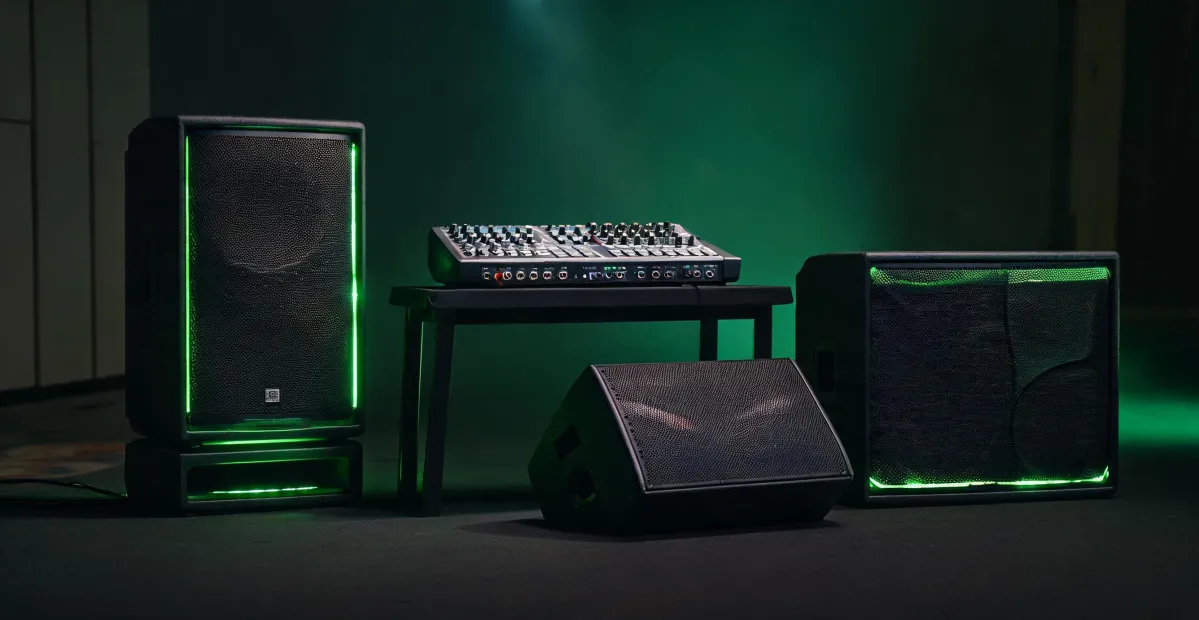
If you’re equipping a small-to-midsize company for meetings, trainings, and occasional live events, my recommendation is simple: start with Mackie powered loudspeakers and a Mackie mixer, not a rack of separate amplifiers. For most rooms under 300 people, a pair of Mackie SRM or Thump tops plus a sub will cover speech, playback, and light music. Add Mackie stage monitors only when you have presenters or performers who need to hear themselves. Use Mackie Bluetooth speakers for breakout rooms and informal spaces. If you already own passive speakers, an Ashly FX750.4 4-channel power amplifier is a legitimate rack option—but it’s not my first purchase. A drone with loudspeaker is a niche tool, not a general AV line item.
That’s the conclusion. Now the why.
Why I’m qualified to have an opinion (and where it comes from)
I’m the office administrator for a 180-person company. I manage AV, facilities, and event ordering—roughly $85,000 annually across 12 vendors. I report to operations and finance. I’m not a sound engineer. I’m the person who gets the request at 4:30 p.m. on Thursday because the Friday all-hands “needs better sound.”
When I took over purchasing in 2020, our AV closet was a graveyard of mismatched gear: one passive speaker with a blown tweeter, a power us amplifier that nobody could wire correctly, and a wireless mic system with no receiver. In our 2024 vendor consolidation project, I had to standardize AV orders across three locations. That’s when I started caring less about spec-sheet bragging rights and more about whether the gear would work when a VP walked on stage.
The powered-vs-passive decision that changed our standard
I went back and forth between a passive speaker + rack amp setup and Mackie powered speakers for about two weeks. Passive offered flexibility: one rack could drive multiple speakers. Powered offered fewer cable runs, simpler setup, and easier troubleshooting. Ultimately we chose powered because our team is not full-time AV staff. The setup had to be fast and predictable.
That doesn’t make passive wrong. If you have installed speakers in ceilings, a rack amp like the Ashly FX750.4 4-channel power amplifier can make sense. It’s a 4-channel amp, so it can drive multiple zones. But for portable events, every extra box is another thing to forget, trip over, or plug in wrong. In my experience, simplicity beats theoretical flexibility.
Where Mackie made sense—and where it didn’t
Powered tops and subs: the no-brainer
For general sessions, Mackie powered tops are basically the default. We use a pair of Mackie SRM tops over a sub for larger rooms and Thump tops for smaller breakouts. They’re fairly easy to set up, and the built-in mixing on some models means we don’t always need a separate mixer. Bottom line: for 80% of our events, a powered Mackie system is enough.
Mackie stage monitors: only if you have performers
We added Mackie stage monitors after a company talent show where the singers couldn’t hear the backing track. That was a red flag. If your events are mostly PowerPoint and panel discussions, skip monitors. If you have live music, worship-style performances, or presenters who pace the stage, monitors are worth it. We use Mackie wedges angled toward the performer. They’re not glamorous, but they solve a specific problem.
Mackie Bluetooth speakers: convenience with a caveat
For breakout rooms and lobby playback, Mackie Bluetooth speakers are convenient. We use them for background music and small presentations. The caveat: Bluetooth is not a professional wireless protocol. It’s fine for one speaker and a phone. It’s not fine for a 12-speaker synchronized audio system. I assumed “party mode” or “stereo linking” would be reliable across all brands. Didn’t verify. Turned out some cheaper speakers drifted out of sync by 200–300 ms. For corporate use, that’s a deal-breaker. If you need multi-room audio, use a wired solution or a proper wireless system.
Power amps: when the Ashly FX750.4 makes sense
If you already have passive speakers, the Ashly FX750.4 4-channel power amplifier is a solid, rack-mountable option. It’s not a brand I’d attack—it’s just a different architecture. You’ll need speaker cable, rack space, and someone who understands impedance and channel bridging. For a portable kit, that’s a lot of extra work. For a permanent install, it can be efficient. The phrase power us amplifier gets used loosely online, so clarify whether you’re buying a power amplifier or a powered loudspeaker. They are not interchangeable.
Drone with loudspeaker: niche, not standard
A drone with loudspeaker is the most specialized item on this list. We looked at one in 2023 for outdoor safety announcements. It was expensive, regulated, and required a trained operator. The audio quality was not good enough for music, and the battery life was shorter than the spec sheet implied. If you have a specific aerial announcement use case—large outdoor area, no other PA access—it might be justified. For a company event, it’s probably a shiny object. We returned ours.
The mistake that made me stricter about power
Saved $180 by buying a no-name power amp instead of a Mackie powered speaker. Ended up spending $650 on a replacement and labor after it clipped during a client demo (this was back in 2022). The “budget” choice looked smart until it failed at the worst possible time. Net loss: $470, plus a very uncomfortable apology email. Now I verify continuous power ratings, not peak watts. A power us amplifier or any amp can look good on paper with inflated peak numbers. Continuous RMS power is what matters.
Why I now pay for certainty on event gear
In March 2024, we paid $400 extra for rush delivery on a Mackie subwoofer. The alternative was missing a $15,000 client event. The standard shipping quote was cheaper by about $120, but it was “probably” going to arrive the day before. After getting burned twice by “probably on time” promises, we now budget for guaranteed delivery on anything event-critical. In urgent situations, “probably” is the biggest risk. The rush fee bought certainty, not just speed. If a speaker arrives late, the cost isn’t the speaker—it’s the room full of people staring at a dead stage.
What I’d buy today for a 200-person company event
- Main PA: Mackie powered tops + one sub. For most indoor rooms, that’s enough.
- Monitors: Mackie stage monitors only if you have live performers.
- Breakouts: Mackie Bluetooth speakers for casual rooms; wired for anything critical.
- Rack option: Ashly FX750.4 4-channel power amplifier only if you already own passive speakers or need installed zones.
- Aerial sound: Drone with loudspeaker only for a specific outdoor use case, not as a general purchase.
Boundary conditions: when this advice doesn’t apply
If you’re a rental house, a touring production, or a permanent install with complex zoning, my conclusion may not fit. Rental companies need inventory that survives abuse and riders; they may standardize on passive boxes and racks for good reason. Large venues need line arrays, not portable Mackies. And if you already have a rack of amps, don’t throw them away—just don’t buy more unless you have a clear use.
Also, pricing and specs change. As of January 2025, Mackie’s powered speakers and the Ashly FX750.4 are widely listed online, but availability varies. Verify current specs, return policies, and warranty terms before ordering. I’d probably still choose Mackie powered first for a corporate events kit—but that’s a judgment call, not a universal law.
If you ask me, the real rule is: buy the simplest system that reliably does the job. For most B2B events, that’s Mackie powered speakers, a couple of monitors if needed, and Bluetooth only for the low-stakes stuff.

Elise Marceau
Elise Marceau is an LED display and digital-signage systems analyst covering LED video walls, modular screens, transparent LED, control processors, and indoor or outdoor signage. She applies IEC 62368-1 safety principles while comparing pixel pitch, luminance, contrast, refresh rate, colour uniformity, viewing angle, ingress protection, power density, module serviceability, and signal redundancy. Her specification guides help integrators, venue operators, retailers, and procurement teams align viewing distance, ambient light, content format, installation access, electrical load, and lifecycle support.