FAQ: What a Procurement Manager Actually Checks Before Buying PA Speakers
-
FAQ: What a Procurement Manager Actually Checks Before Buying PA Speakers
-
Q: How do you tell whether a PA speaker is a good deal or just cheap?
-
Q: What is a Mackie Thump 215 actually good for?
-
Q: When is a 15-inch subwoofer worth the money?
-
Q: How does loudspeaker application change what you actually need?
-
Q: Powered speakers or external amplifiers — which is cheaper?
-
Q: What is the most common hidden cost in audio gear purchasing?
-
Q: How do you tell whether a PA speaker is a good deal or just cheap?
FAQ: What a Procurement Manager Actually Checks Before Buying PA Speakers
I manage procurement for a 40-person event rental company. Our audio equipment budget runs about $180,000 a year, and I've been tracking every invoice, RMA, and repair cost for six years.
Below are the answers I wish someone had given me before I signed my first purchase order for a Mackie system. No sales pitch — just what actually shows up on the spreadsheet.
Q: How do you tell whether a PA speaker is a good deal or just cheap?
TCO. Total cost of ownership. Every single time.
In Q2 2023, I compared four powered speakers for our rental fleet. The cheapest quoted around $280 per unit. The Mackie Thump 215 speaker came in mid-range, roughly $400. I almost went with the cheapest option — until I ran the three-year numbers.
The cheap speaker went through three warranty claims in two years. Return shipping ran about $120 per box out of our own pocket. Meanwhile, the oldest Thump 215 in our fleet — bought in 2022 — had zero service events.
The sticker difference was $120 per unit. The actual three-year cost difference worked out to about $85 per unit, in favor of the Mackie. Not saying a Thump 215 is right for every scenario. But the lowest quote is rarely the lowest total cost.
Q: What is a Mackie Thump 215 actually good for?
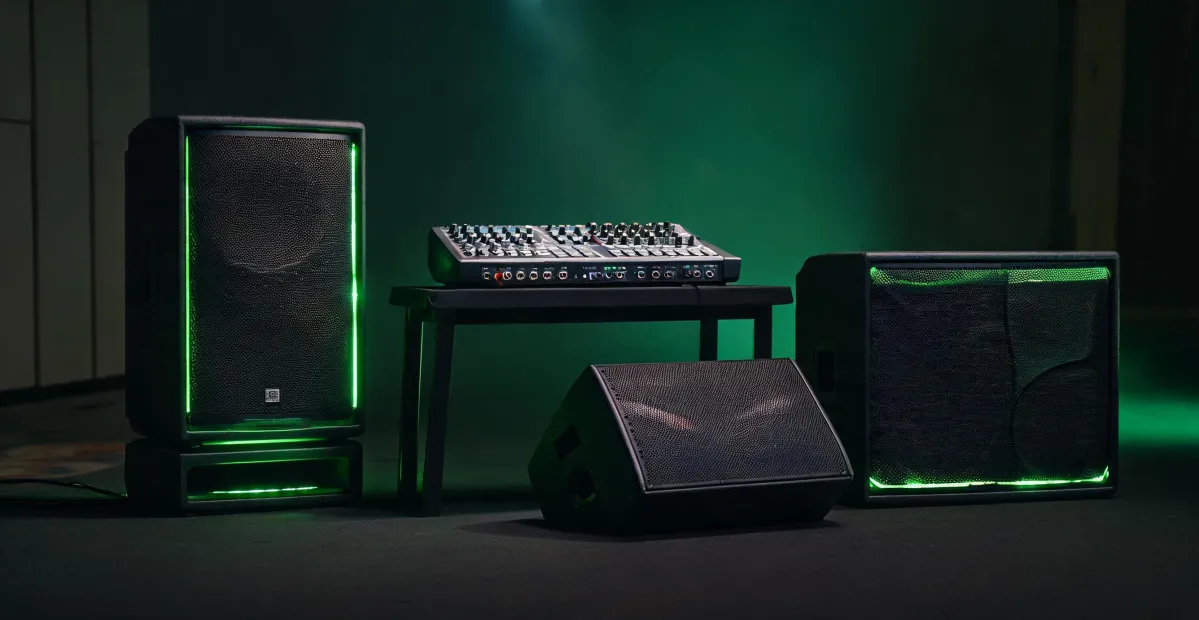
Based on our rental logs, it's the workhorse box. It fits:
- Live shows in rooms under 200 people
- Rental deployments that need fast setup and teardown
- DJ and background-music jobs where one box has to cover a wide frequency range
- Weight-sensitive gigs — the 215 runs about 32 lbs, versus 45+ for a passive speaker plus an amp rack
Where it doesn't fit: anything over 500 people, or replacing a proper line array. But honestly, most of our rental orders are small to mid-size jobs. The Thump handles them without breaking the labor budget.
I should add: we had to rebuy two cheap speakers we originally bought as “backups.” Learned that lesson the hard way in early 2023.
Q: When is a 15-inch subwoofer worth the money?
It depends on what spaces you're actually serving.
We run eight subs — five of them are Mackie subwoofer 15 models. My biggest regret was skipping a sub pair on a 120-seat jazz club project back in 2022. Bass guitar and kick drum turned to mud, the client complained, and we spent more retrofitting than if we'd just bought the subs upfront.
My rule of thumb now:
- Rooms over 150 people → you need one
- Any genre with punchy low-end (EDM, hip-hop, rock) → you need one
- Top boxes are 12-inch → you need one for low-frequency extension
A 15-inch sub hits the sweet spot between extension and portability. 12-inch saves money but you trade low-end extension. 18-inch is a size and cost jump that only makes sense for outdoor or larger rigs.
Q: How does loudspeaker application change what you actually need?
This is the thing I wish every customer understood before asking for a quote — because loudspeaker application determines the entire budget structure.
We categorize every job into four buckets:
- Portable live sound — Powered speakers with built-in amps. A Mackie Thump 215 sits here. Fast setup, fewer cables, no external amp. Rental workflow.
- Fixed installation — Passive speakers with external amplification. Cleaner installation, centralized control. Different team, different budget line.
- Studio and recording — A separate budget entirely. We spent roughly $200 on a Scarlett audio mixer/interface last year for demo recordings. Not a PA device — but if you can't get audio into a computer, you can't bill for post-production either.
- Hi-fi and custom install — A residential listening room or a hybrid install. A stereo power amplifier in the Anthem MCA 225 Gen 2 class runs $1,100–$1,500. Not our rental fleet category, but it crosses our purchasing path when we quote hybrid projects.
If a sales rep can't tell you which bucket your job falls into, they can't quote you accurately. That's usually where budget overruns start.
Q: Powered speakers or external amplifiers — which is cheaper?
Depends on the application, not the price tag.
- Powered PA (e.g., Mackie Thump 215): Higher per-unit cost, but no amp rack needed. Fewer cable runs, faster setup, better for rental. We budget roughly $400 per box and that's the whole line item.
- Passive + amplifier: Lower speaker cost, but you add the amp. A stereo power amplifier like the Anthem MCA 225 Gen 2 stereo power amplifier runs $1,100–$1,500 installed. Fine for a fixed install — irrelevant for portable rental.
- Studio audio interface (e.g., a Scarlett audio mixer/interface): A completely separate budget line at about $200. This is for recording, not live sound.
Key insight: don't mix budgets. A rental company buying a Scarlett to use as a live PA mixer is going to have a very bad weekend.
Q: What is the most common hidden cost in audio gear purchasing?
Accessories. Hands down.
When I audited our 2023 spending, 23% of our “audio equipment” budget was actually cables, pole mounts, covers, and cases. None of that shows up on the initial speaker quote. It lands on the second invoice — and it's where the budget quietly breaks.
We now require a “system total” quote covering every cable, mount, cover, and case before we sign anything. That single policy change took our overruns down about 40% in 2024.
One of the other procurement leads in our building still orders speakers and accessories separately. He'll figure it out eventually. Or his CFO will.

Elise Marceau
Elise Marceau is an LED display and digital-signage systems analyst covering LED video walls, modular screens, transparent LED, control processors, and indoor or outdoor signage. She applies IEC 62368-1 safety principles while comparing pixel pitch, luminance, contrast, refresh rate, colour uniformity, viewing angle, ingress protection, power density, module serviceability, and signal redundancy. Her specification guides help integrators, venue operators, retailers, and procurement teams align viewing distance, ambient light, content format, installation access, electrical load, and lifecycle support.